Refractor vs Reflector Telescope: Which Fits You? (October 2026)
A refractor uses a lens and a reflector uses a mirror, and that difference shapes the size, care and aperture of each telescope. Pick a refractor for a compact scope with crisp Moon views, and pick a reflector for more aperture for the money.
On this page (14 sections)
- How a refractor works
- How a reflector works
- Image quality on the Moon and planets
- Aperture and light gathering
- Cost and value for the same aperture
- Size, weight and setup
- Eyepiece height and comfort
- Upkeep and dust
- Sky conditions and where you observe
- Which fits a first telescope?
- Sun safety for both designs
- What to check before you buy
- Common mistakes when choosing
- Refractor or reflector: which telescope design fits you
A refractor suits a compact, low-upkeep first telescope, and a reflector gives more aperture for the money. Their names describe how each one gathers light.
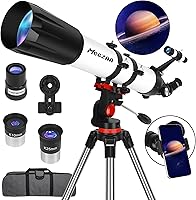
A refractor sends light through a lens at the front of the tube. A reflector catches light with a curved mirror at the bottom of the tube.
Both can show the Moon, the planets and bright star clusters. The right pick depends on how much you want to carry, how much you want to spend and how much care you're willing to give the scope.
How a refractor works
Light enters a refractor through the lens at the front and bends to a focus at the eyepiece. There is one main lens to clean and nothing inside the tube to align, which keeps the setup simple.
Cheaper refractors often show a faint color fringe around bright objects such as the Moon or Venus. That fringe is called chromatic aberration, and better lenses reduce it.
A 90 mm refractor still shows the Moon and planets clearly. A little color can appear at high power, so the best views usually come at moderate magnification.
Refractors also suit a grab-and-go routine. A compact tube travels well in a car, and a refractor on a tripod goes up quickly on a patio or a park lawn.
How a reflector works
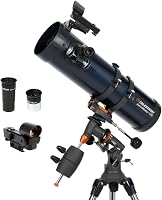
A reflector uses a large curved mirror at the bottom of an open tube. The mirror reflects light up to a smaller flat mirror, which sends the image out the side to the eyepiece.
Because the mirror does the gathering, a reflector can have a bigger aperture than a refractor at a similar cost. That is why most beginner kits with a 114 mm or 130 mm aperture are reflectors.
Reflectors have no color fringe from the mirror itself. Their tubes stay open, though, so dust settles on the mirror over time.
The mirror also needs an occasional check to keep its alignment, a process called collimation. The job takes a few minutes once you know the steps.
Image quality on the Moon and planets
A good refractor gives crisp, high-contrast views of the Moon. The craters and the line between light and shadow look clean at moderate power.
Planets show as sharp discs through a well-made refractor. A reflector gathers more light for the same money, which brings out faint detail on Jupiter's bands and gives Saturn's rings a brighter look.
A poorly aligned reflector can look soft, and the fix is a few minutes of adjustment.
Refractor vs reflector: what you see
Contrast matters as much as brightness on the Moon. A refractor's clean view can make small craters easier to pick out at moderate power.
A reflector's extra light helps more on fainter targets, such as star clusters and the brighter galaxies. Neither design turns a small scope into a deep-sky instrument.
Aperture and light gathering
Aperture is the diameter of the main lens or mirror, and it decides how much light the scope gathers. A 130 mm mirror gathers about twice the light of a 90 mm lens, since the light-gathering area grows with the square of the diameter.
That gap matters most on faint targets. A larger aperture shows more points of light in a cluster and a brighter smudge on a galaxy.
Bigger isn't always better for a first scope. A larger aperture means a heavier tube and more to set up, so the right size is the one you'll carry outside on a clear night.
Cost and value for the same aperture
For a given aperture, a refractor is harder to make than a reflector, because a large lens is harder to produce than a large mirror. That is why most buyers see more aperture from reflectors in the same budget.
For a first scope, the value question is what you can carry and use, not only the number on the box. A bigger aperture that stays in the garage teaches you less than a smaller one used on every clear night.
Size, weight and setup
Refractors tend to be long, narrow tubes on a tripod. A 90 mm refractor is compact, and many come with a carry bag, so it suits trips and short sessions.
Reflectors use a wider tube. A tabletop reflector such as the Heritage 130 sets up on a table without a tripod, so it skips the tripod step entirely.
A reflector on a tripod, like the StarSense Explorer LT 114AZ, needs more floor space. In return, it adds a phone app that guides the scope to targets.
Eyepiece height and comfort
A refractor's eyepiece sits at the back of the tube, which can land at a comfortable height on a tripod. A reflector's eyepiece sits near the top or side of the tube, so the height depends on the mount.
On a tabletop Dobsonian, the eyepiece sits high on the tube, so you may need a small stool or a seat at the table. Check your sitting or standing height before you choose, since a sore neck ends a session early.
Upkeep and dust
A refractor has one main lens at the front of the tube, so there is less glass to clean. Keep the dust cap on when the scope is not in use, and clean the lens gently only when it needs it.
Refractor and reflector upkeep
Reflectors need more attention. The mirror collects dust, and it may need collimation every so often.
Collimation is a simple skill. Check the manual for the steps, then confirm the result on a bright star in the eyepiece.
Sky conditions and where you observe
Both designs need a dark, open sky. A street lamp, a tall tree or a neighbor's porch light hurts either one in the same way.
That means the site often matters more than the design. A backyard with a clear view to the south will serve either scope better than a cramped balcony, whatever the tube looks like.
Which fits a first telescope?
A refractor suits a buyer who wants something compact, easy to carry and simple to keep. A 90 mm refractor works well for the Moon and bright planets, and it's a good family scope for trips.
A reflector suits a buyer who wants more aperture for the money. A 114 mm or 130 mm reflector gathers more light than a 90 mm refractor, which helps with faint targets.
If the scope will live on a patio or a table, a tabletop Dobsonian reflector is often the simplest route. If the scope needs to travel, a refractor or a smaller reflector on a tripod is easier to move.
Sun safety for both designs
Never point a refractor, a reflector or either finder at the sun, even for a moment. Looking at the sun through an unfiltered telescope can cause permanent eye damage.
What to check before you buy
Check the mount first, since a good mirror or lens is wasted on a wobbly base. Look for a tripod that adjusts in height and locks firmly.
Check the weight and the storage space next. A scope you can carry to the yard gets used far more often than one that stays in a closet.
Check what comes in the box, including eyepieces, a finder and a carry bag. Those extras add up, and a kit with a finder saves time on the first night.
Common mistakes when choosing
- Buying the biggest aperture without checking the mount. A large scope on a wobbly tripod is hard to use.
- Choosing by magnification numbers. Power depends on the eyepiece, and high power on a small scope looks dim and soft.
- Ignoring how the scope will be moved. A heavy tube that stays in the garage gets used less than a lighter one.
- Expecting a refractor to show deep-sky detail the way a larger reflector can.
Refractor or reflector: which telescope design fits you
Pick a refractor if you want a compact, low-upkeep telescope with crisp views of the Moon and bright planets. Pick a reflector if you want more aperture, a tabletop base or a better chance at faint star clusters.
Both are good first telescopes, and the better one is the one that gets used. If you're still choosing, how to choose a telescope for beginners walks through the other factors, such as mount and budget.
For a side-by-side look at binoculars, read telescope vs binoculars for stargazing. For a reflector on a tripod, the Celestron AstroMaster 130EQ review shows what a bigger mirror asks of you.
Frequently asked questions
Is a refractor or a reflector better for a beginner?
Neither is better for everyone. A refractor suits someone who wants a compact, low-upkeep scope for the Moon and planets, while a reflector suits someone who wants more aperture and doesn't mind occasional alignment.
Which is better for planets, a refractor or a reflector?
Both show planets well on a steady night. A good refractor gives crisp, high-contrast planet views, and a 130 mm reflector gathers more light, which helps show detail on Jupiter and Saturn.
Do reflectors need more maintenance than refractors?
Yes, a little, because the mirror collects dust and can need collimation. A refractor has one main lens, so there is less to clean and nothing to realign.
Can a reflector show color fringes?
Not from the mirror itself. A mirror reflects every color the same way, so a reflector doesn't show the color fringe that some cheaper refractors show around bright objects like the Moon.