Celestron AstroMaster 130EQ Review: Worth It? (October 2026)
The Celestron AstroMaster 130EQ is a 130 mm reflector on a German equatorial mount, which gives you a bigger mirror but asks you to learn the mount. It suits a patient beginner who wants more light than a 114 mm scope, and it's a weaker pick for someone who wants the easiest first night.
On this page (19 sections)
- Celestron AstroMaster 130EQ at a glance
- Is the AstroMaster 130EQ good for beginners?
- What an equatorial mount means for you
- Slow-motion knobs and aiming
- What you can see with a 130 mm reflector
- 130 mm and 650 mm: what the numbers mean
- Setup, weight and carrying
- Compared with the other 130 mm options
- Learning the equatorial mount over several nights
- Eyepiece swaps and focus on the 130EQ
- Star hopping with the red dot finder
- Who gets the most from this scope
- Collimation on the 130EQ
- Using the StarPointer after dark
- What comes in the box
- Pros and cons
- Who should skip the AstroMaster 130EQ
- Sun safety with a finder and a tube
- Verdict: the Celestron AstroMaster 130EQ for a patient beginner
The Celestron AstroMaster 130EQ is a 130 mm reflector on a German equatorial mount, with a bigger mirror than the popular 114 mm beginner scopes. It's a good scope for a beginner who wants more light and doesn't mind learning how the mount works.
This review covers the mount, what the scope shows, the setup time and the trade-offs. It also covers who should skip it, since the mount is the main hurdle for a first-time owner.
Celestron AstroMaster 130EQ at a glance
The AstroMaster 130EQ has a 130 mm mirror, a 650 mm focal length and a German equatorial mount with slow-motion control knobs. It comes with 20 mm and 10 mm eyepieces and a StarPointer red dot finder built onto the tube.
Celestron AstroMaster 130EQ
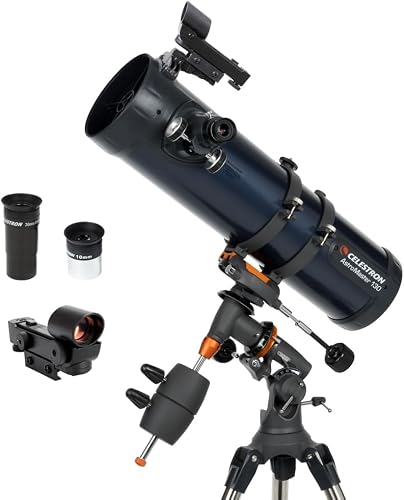
- 130 mm Newtonian reflector
- German equatorial mount with slow-motion knobs
- 20 mm and 10 mm eyepieces
- StarPointer red dot finder included
A bigger mirror than the popular 114 mm beginner scopes, for a buyer who will learn the equatorial mount and wants more light.
Pros
- A 130 mm mirror gathers more light than a 114 mm one
- Slow-motion knobs on both axes for smooth aiming
- Includes a red dot finder and two eyepieces
Cons
- The equatorial mount takes practice
- About 17 pounds to carry and set up
Our score weighs specs, features and buyer feedback against what you're shopping for.
Is the AstroMaster 130EQ good for beginners?
It can be, for a beginner who is patient. The mirror is a real step up from a small refractor, and the scope gives a clear look at the Moon and planets once it's set up.
It's a harder first night than a phone-guided scope. You'll spend time learning the mount and finding targets by hand, so the first clear night may feel slow.
What an equatorial mount means for you
An equatorial mount is tilted to line up with the sky's rotation, which is the Earth's turning seen from the ground. Once aligned, one knob can follow a target as it moves across the sky, so the view stays on the object longer.
Setup takes practice. You aim the mount's polar axis near the celestial pole before the tracking works smoothly, and that step is the one most beginners need to learn.
Celestron AstroMaster 130EQ mount and setup
Set the tripod level and firm before you attach the mount head. Then line up the polar axis, which takes a few tries the first time.
Once the mount is aligned, the knobs do most of the work. Expect the first session to be a learning session, and plan for a second, easier one on the next clear night.
Slow-motion knobs and aiming
The AstroMaster has two slow-motion control knobs, one for each direction of the mount. Celestron describes them as the way to aim and center a target with smooth, small moves.
The StarPointer red dot finder sits on the tube and helps you line up a target before you look. Keep both eyes open when you use it, and check the eyepiece once the dot sits on the target.
What you can see with a 130 mm reflector
The Moon shows craters and shadows along its edge, and bright planets show more detail than a smaller scope can. Jupiter's bands and moons appear on a steady night, and Saturn's rings show as a clear shape.
Bright star clusters look bright and full of points of light. Galaxies such as Andromeda show as faint, small smudges, which is normal for a beginner reflector under typical skies.
130 mm and 650 mm: what the numbers mean
The 650 mm focal length gives about 33 times power with the 20 mm eyepiece and about 65 times with the 10 mm. Those are the two powers you'll use most on a first night.
Higher power isn't the goal. At 65 times the image is dimmer and shakes more with any breeze, so start at the lower power and move up only when the view stays steady.
Setup, weight and carrying
The scope weighs about 17 pounds, which is heavier than the 10.4 pound StarSense Explorer LT 114AZ. The tripod and mount add to the load, so plan on one trip to the car and a second for the eyepieces.
The tripod needs a level, firm spot. A loose or wobbly tripod shakes the view, and it hurts the equatorial mount more than an altazimuth one.
Compared with the other 130 mm options
A 130 mm Dobsonian gives a similar mirror with a simpler mount. It sits on a table and needs no polar alignment, which makes it easier for a quick session.
The Sky-Watcher Heritage 130 Tabletop Dobsonian Review covers that option. The StarSense 114AZ gives you guided targets with a smaller mirror, and the StarSense vs AstroMaster comparison covers that trade.
For the bigger tabletop choice, the Heritage 130 vs 150 comparison lays out the Dobsonian pair.
Learning the equatorial mount over several nights
Plan the first three clear nights around one job each. On the first night, set up the tripod and the polar alignment, then find the Moon and nothing else.
On the second night, aim at a bright planet and practice the knobs. On the third, try a star cluster and see how smoothly the tracking follows the target.
Eyepiece swaps and focus on the 130EQ
The 20 mm and 10 mm eyepieces give different views, and each one needs a small focus adjustment after a swap. Keep the focus turns slow and steady, since a quick turn can overshoot the sharp point.
Once you know the focus point for each eyepiece, mark it on a strip of tape. That small step saves time on the next session.
Star hopping with the red dot finder
The StarPointer is an aiming tool, but it doesn't find targets for you. You still need to know where a star or planet sits in the sky.
Star hopping means moving from a bright, easy star to a fainter target by following a path of stars. It takes practice, but it's the skill that makes the equatorial mount feel useful.
Who gets the most from this scope
A buyer who enjoys routines and small tuning steps will get the most from the 130EQ. A patient observer who wants to study the Moon and planets in detail will also enjoy the mirror.
A buyer who wants quick results should choose a guided scope instead, since the first month may feel slow. The mount rewards repeat sessions more than one-off outings.
Collimation on the 130EQ
Like any Newtonian, the 130EQ's mirrors can drift out of alignment over time. A simple check with a bright star in the eyepiece shows whether the view is sharp and centered.
Keep the tube capped between sessions, since dust on the mirror softens the view more than most first-timers expect. Check the manual for the steps to align the mirrors.
Using the StarPointer after dark
Check the finder's battery before a session, and set the dot's brightness low so your eyes stay adjusted. A brighter dot is easier to see in town, but a dim dot keeps your night vision intact.
Once you've centered a target in the finder, check the eyepiece before you move the scope again. That habit prevents the common mistake of chasing a target that is already in view.
What comes in the box
The box holds the 130 mm tube, the preassembled tripod and equatorial mount, and a 10 mm eyepiece. The 20 mm eyepiece has a built-in erect image corrector, so land views come out upright.
Celestron also includes a built-on StarPointer finder and a free download of TheSkyX First Light software. The scope carries a two-year US warranty.
Pros and cons
- Pros: a 130 mm mirror gathers more light than a 114 mm scope, which helps on planets and bright clusters.
- Pros: the slow-motion knobs make small moves smooth, and the StarPointer finder is included.
- Cons: the equatorial mount takes practice, and the first setup can feel slow.
- Cons: about 17 pounds to carry and set up is more than a light tripod scope.
Who should skip the AstroMaster 130EQ
Skip it if you want to see targets on your first try. A phone-guided scope such as the StarSense Explorer LT 114AZ is the faster start.
Skip it if you need a grab-and-go scope for quick trips. The mount and the weight make the AstroMaster a planned session, not a quick look.
Skip it if you want a tabletop scope. The 130EQ sits on a tripod, so it needs floor space and a solid spot.
Sun safety with a finder and a tube
Never point the tube or the red dot finder at the sun, even for a moment. Looking at the sun through an unfiltered telescope can cause permanent eye damage, and the finder is no safer than the main tube.
Verdict: the Celestron AstroMaster 130EQ for a patient beginner
The Celestron AstroMaster 130EQ gives a bigger mirror than most beginner scopes, and it rewards a patient owner. It's a good pick for someone who will learn the equatorial mount and wants more light for planets.
For planet targets once the scope is set up, how to find planets with a telescope walks through the steps.
Frequently asked questions
Is the AstroMaster 130EQ good for beginners?
Yes, if you're patient. It's a capable first reflector, but the equatorial mount takes practice, so it's a better fit for someone who is happy to learn the setup than for a buyer who wants to see targets on the first try.
What is an equatorial mount?
It's a mount tilted to line up with the sky's rotation, so one knob can follow a target across the sky. Setup takes time, since you have to aim the mount's polar axis toward the celestial pole before the tracking works smoothly.
Does the AstroMaster 130EQ come with a finder?
Yes, it includes a StarPointer red dot finder, which helps you aim the scope at a target before you look through the eyepiece. It's a useful tool on a first night.
Can the AstroMaster 130EQ show Saturn's rings?
Yes, on a steady night. Saturn's rings show as a clear shape through a 130 mm reflector, along with Jupiter's bands and moons, though the view is small and needs patience to find and focus.