Celestron StarSense Explorer vs AstroMaster: Which Is Better? (October 2026)
The StarSense Explorer LT 114AZ is the easier first night, because a phone app points you toward targets, while the AstroMaster 130EQ gives a bigger mirror on a mount you have to learn. Pick the StarSense if you want guided targets, and pick the AstroMaster if you want more aperture and are happy to learn the mount.
On this page (15 sections)
- Celestron StarSense Explorer vs AstroMaster on the first night
- Aperture: 114 mm against 130 mm
- Mount: altazimuth against equatorial
- How the phone app works
- Eyepieces and what you can see
- Setup, weight and portability
- Which scope fits which buyer
- The first month with each scope
- Upkeep for both Newtonian mirrors
- Who each scope suits after the first year
- What the phone adds and what it can't do
- Eyepiece upgrades for each scope
- Sun safety for both scopes
- Which one should you buy?
- Celestron StarSense Explorer vs AstroMaster: the closing choice
The StarSense Explorer LT 114AZ is the easier first night, because a phone app points you toward targets. The AstroMaster 130EQ has the bigger mirror, but you have to learn its equatorial mount.
Both are Celestron Newtonian reflectors on a tripod, with a mirror of about 4.5 to 5 inches. The big difference is how you find things.
If you want help on your first night, pick the StarSense. If you want more light and don't mind learning the setup, pick the AstroMaster.
 Best for guided targets with a phone
Celestron StarSense Explorer LT 114AZ
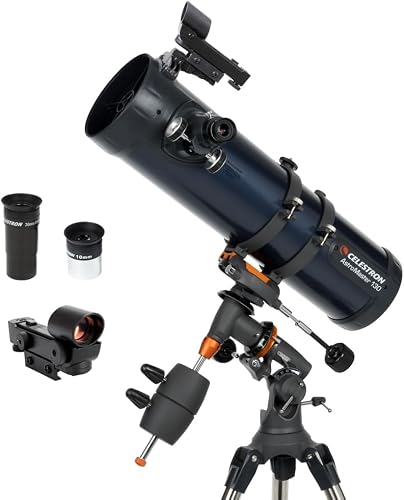 Best for a bigger mirror with slow-motion knobs
Celestron AstroMaster 130EQ
Our score weighs specs, features and buyer feedback against what you're shopping for.
Celestron StarSense Explorer vs AstroMaster on the first night
The StarSense Explorer LT 114AZ is quicker to start. You dock your phone, open the app and follow arrows to the targets it suggests for your time and location.
The AstroMaster 130EQ starts slower. You line up the mount, learn the two slow-motion knobs and then find targets by hand, often with the included red dot finder.
| Product | Best for | Aperture | Mount | Focal length | Our score |
|---|---|---|---|---|---|
| Celestron StarSense Explorer LT 114AZ | guided targets with a phone | 114 mm | Altazimuth | 1000 mm | 8.7 |
| Celestron AstroMaster 130EQ | a bigger mirror with slow-motion knobs | 130 mm | Equatorial | 650 mm | 7.3 |
Aperture: 114 mm against 130 mm
The AstroMaster 130EQ has a 130 mm mirror, and the StarSense has a 114 mm one. The bigger mirror gathers about 30 percent more light, since the light-gathering area grows with the square of the diameter.
That extra light helps on faint targets, such as star clusters and fine detail on planets. The gap is real but modest.
The StarSense's phone guidance can make up for some of that difference, because it gets you on target faster. A scope that you use every clear night will show you more than a bigger scope that stays in the garage.
Mount: altazimuth against equatorial
The StarSense uses an altazimuth mount, which moves up and down and side to side. It's simple to use, and the altitude slow-motion control makes small moves easier.
That simple motion also lines up well with the phone's arrows, since each arrow asks for a move in one of those directions.
The AstroMaster uses a German equatorial mount, which is tilted to line up with the sky's rotation. Once aligned, one knob can follow a target across the sky.
Celestron StarSense Explorer and AstroMaster mounts
Setting up the AstroMaster's equatorial mount takes practice and patience. A first-time owner may spend part of the first session just learning the alignment.
The StarSense mount needs much less learning. Celestron ships the mount and tripod preassembled, so you set it up and let the phone guide the aim.
How the phone app works
Celestron says the StarSense app recognizes the sky and builds a list of targets for your time and location. You dock the phone on the scope, then follow the on-screen arrows until the target sits in the eyepiece.
Celestron says the app works with Android 12 and later and iOS 18 and newer, including iPhone XR and newer. It needs a charged phone and a clear sky, and it can't guide you through clouds, and it works best when you let it lead the first few targets before you try to find things by hand.
Eyepieces and what you can see
The StarSense comes with a 25 mm and a 10 mm eyepiece, plus a 2x Barlow lens. On its 1000 mm focal length, the 25 mm gives about 40 times power and the 10 mm gives about 100 times.
The AstroMaster comes with a 20 mm and a 10 mm eyepiece. On its 650 mm focal length, the 20 mm gives about 33 times and the 10 mm gives about 65 times.
Both scopes show the Moon well and give bright planets a clear look on a steady night. Neither is built for galaxies, which look small and faint from either one, so set that expectation before you buy.
Setup, weight and portability
The StarSense weighs about 10 pounds, which makes it the lighter choice to carry from a garage or closet. Its mount and tripod arrive preassembled, and the phone does the aiming work.
Both scopes set up on a patio or a lawn, but the StarSense also needs a phone charged and docked, which takes a minute.
The AstroMaster weighs about 17 pounds, and the equatorial mount adds some bulk. It sets up well for a patio or yard session, though it's less convenient for a quick trip out the door.
Which scope fits which buyer
The StarSense fits a buyer who wants to see targets soon after the first setup. It also fits someone who is nervous about learning a mount and wants a guided first month.
The AstroMaster fits a buyer who wants more light and is ready to learn. It suits someone who enjoys the process of alignment and expects to keep the scope for years.
Both scopes suit a family or a shared backyard. The key question is whether the first user wants a fast reward or a longer learning curve.
The first month with each scope
With the StarSense, expect to spend the first week learning the app, the dock and the arrows. By the second or third clear night, the phone guidance feels routine, and you can start learning to find targets by hand.
With the AstroMaster, the first week goes to the mount. Once you can align it and follow the Moon, planets become the next step, and the slow-motion knobs make small moves easier.
Either way, plan a few short sessions rather than one long one. Short sessions build the habit and keep the scope out of the closet.
Upkeep for both Newtonian mirrors
Both scopes are Newtonian reflectors, so both need the mirror kept clean and aligned from time to time. Cap the tube when the scope is not in use to keep dust off the mirror.
Collimation is a simple check you can do yourself with a bright star. Plan for it before a big session, since a misaligned mirror softens the view on every target.
Who each scope suits after the first year
After a year, the app's guidance matters less once the sky is familiar. A StarSense user can use the 114AZ for quick looks and add a finder-based routine for more skill.
An AstroMaster user, after a year of practice, may want a steadier mount or a bigger mirror. Both paths make sense, and the first scope teaches the skills that the next one needs.
What the phone adds and what it can't do
The phone adds guidance, a list of targets and a faster route to the first view. It can't add clear sky, a steadier mount or extra light, so the basics still matter.
Think of the app as a teacher for your first months. The scope still gives you the view, and the mirror size and the mount decide how good that view can be.
Eyepiece upgrades for each scope
The StarSense's 25 mm and 10 mm eyepieces are a good start, and a wide-field eyepiece later adds a bigger view. The AstroMaster's 20 mm and 10 mm work the same way, so an upgrade changes either scope in a similar way.
Check the barrel size in the manual before you buy an eyepiece. Matching the barrel avoids a return and a wasted weekend.
Sun safety for both scopes
Never point either scope, or its finder, at the sun, even for a moment. Looking at the sun through an unfiltered telescope can cause permanent eye damage, and a phone app or red dot finder doesn't make it safer.
Which one should you buy?
Pick the StarSense Explorer LT 114AZ if you want a guided first night and a lighter scope. It's the better choice for most first-time buyers who want to see targets soon after the box opens.
Pick the AstroMaster 130EQ if you want the bigger mirror and a mount you can learn over time. It rewards patience, and the extra light helps on planets once you're comfortable with the setup.
Celestron StarSense Explorer vs AstroMaster: the closing choice
Both scopes are good starts, and the right one depends on how you like to learn. The StarSense teaches you the sky with help, and the AstroMaster teaches you the mount as you go.
For the full review of the StarSense, read Celestron StarSense Explorer LT 114AZ Review. For the AstroMaster, see Celestron AstroMaster 130EQ Review.
If you want to learn the app first, how to use Celestron StarSense walks through setup.
Frequently asked questions
Is the StarSense Explorer better than the AstroMaster 130EQ?
For a first night, usually yes, because the phone app does much of the finding. The AstroMaster 130EQ has more aperture, so it may suit a buyer who wants more light and is willing to learn an equatorial mount.
Does the StarSense Explorer need a phone?
Yes, the guidance runs on your phone, so you need a charged phone and a clear sky. Without the phone, the scope still works as a manual Newtonian on an altazimuth mount.
Is an equatorial mount hard for beginners?
It takes more practice than an altazimuth mount. You tilt the mount to line up with the sky, then use the slow-motion knobs to follow targets, which is smooth once you learn it.
Which one shows more detail on planets?
The AstroMaster 130EQ has the bigger mirror, so it gathers more light and can show slightly more planet detail on a steady night. The difference is modest, and a steady mount matters just as much.