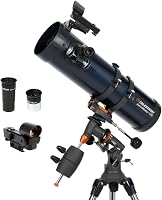
5 Best App-Guided Telescopes (Celestron StarSense), October 2026
The best Celestron StarSense telescopes include the Celestron StarSense Explorer LT 114AZ for most first-time buyers, the Celestron StarSense Explorer LT 80AZ for a lighter app-guided refractor, and the Celestron StarSense Explorer 114AZ Tabletop Dobsonian for a sturdy tabletop base.
On this page (15 sections)
- The 5 best Celestron StarSense telescopes, ranked
- Celestron StarSense models for a first night
- What the app does for a beginner
- How to pick a StarSense model for your space
- Limits of app guidance
- Who should pick StarSense
- Tripod or tabletop: which StarSense setup fits?
- Caring for a StarSense telescope
- What the app teaches over time
- How we picked these five
- Side by side: five StarSense telescopes
- What the app does and doesn't do
- Which StarSense telescope fits your space?
- Keep the sun out of your view
- The best StarSense telescope is the one you'll use on a clear night
The best Celestron StarSense telescope for most adults is the StarSense Explorer LT 114AZ. It pairs a 114 mm reflector on a tripod with a phone app that guides you to targets.
A StarSense telescope docks your phone and uses the phone's camera to read the star patterns overhead. The app then shows on-screen arrows that guide you to the object you picked, which helps a first-timer find the Moon, planets and brighter clusters.
We compared five StarSense models on aperture, mount, weight and what the app does for you. Our score weighs specs, features and buyer feedback against what you're shopping for.
Our picks at a glance
-
1
 Best for most first-time buyers
Celestron StarSense Explorer LT 114AZ
8.7/10 our score
See it on Amazon -
2
 Best for a lighter app-guided refractor
Celestron StarSense Explorer LT 80AZ
8.4/10 our score
See it on Amazon -
3
 Best for a sturdy tabletop base
Celestron StarSense Explorer 114AZ Tabletop Dobsonian
8.3/10 our score
See it on Amazon
- 4
 Check it
Celestron StarSense Explorer 130 mm Tabletop
Best for an app-guided 130 mm tabletop - 5
 Check it
Celestron StarSense Explorer DX 130AZ
Best for a premium mount and a bigger mirror
The 5 best Celestron StarSense telescopes, ranked
Each model keeps the same app and differs in the mirror, the base and the weight. Read the badge first, then check the space you have.
Celestron StarSense Explorer LT 114AZ
- 114 mm Newtonian reflector
- Phone app points you to targets
- Altazimuth mount with a slow-motion rod
- 25 mm and 10 mm eyepieces with a 2x Barlow lens
A balanced first StarSense: a 114 mm reflector on a tripod, with the app guiding each target. It's the model to start with if you want one scope for the Moon, planets and brighter deep-sky objects.
Pros
- The app guides you to targets
- A 114 mm mirror on a tripod
- Celestron offers a 2-year US warranty
Cons
- Needs a phone and a clear sky for the app
- Heavier than the 80 mm model at 10.4 pounds
The LT 114AZ is the most balanced StarSense model here. It has a 114 mm reflector, a 1000 mm focal length and an altazimuth mount on a tripod.
You dock your phone, open the StarSense Explorer app and follow the arrows until the bullseye turns green. Then you look through the eyepiece and see the target.
At 10.4 pounds, it's easier to carry than the tabletop models. Celestron offers a 2-year US warranty and US-based support.
Celestron StarSense Explorer LT 80AZ
- 80 mm refractor with a 400 mm focal length
- Phone app points you to targets
- Altazimuth mount with a manual slow-motion rod
- 25 mm and 10 mm eyepieces with a 2x Barlow
A smaller 80 mm refractor with the same phone guidance. It's the lightest app-guided model here, which makes it easy to carry, but it gathers less light for faint targets.
Pros
- The lightest app-guided model here at 9.2 pounds
- The app guides you to targets
- Celestron offers a 2-year US warranty
Cons
- 80 mm gathers less light than the 114 mm models
- Needs a phone and a clear sky for the app
The LT 80AZ is the lighter StarSense model. It's an 80 mm refractor with a 400 mm focal length, and it weighs 9.2 pounds, the lightest app-guided model in this guide.
The app works the same way. You follow the arrows to a target, and the app builds a list of the top objects for your time and place.
The 80 mm aperture gathers less light than the 114 mm reflector, so faint targets look dimmer. It's a good choice when portability matters more than the last bit of detail.
Celestron StarSense Explorer 114AZ Tabletop Dobsonian
- 114 mm Newtonian reflector, same aperture as the LT 114AZ
- Phone app guides you to targets
- Tabletop Dobsonian-style base
- StarPointer finder and 17 mm and 10 mm eyepieces
The same 114 mm aperture as the LT 114AZ, on a tabletop base with no tripod to set up. It works best when you have a steady table or stand.
Pros
- Same 114 mm aperture as the LT 114AZ
- A simple tabletop base with no tripod
- Celestron offers a 2-year US warranty
Cons
- Needs a sturdy table or stand
- Heavier than the LT 114AZ at 12.6 pounds
The 114AZ tabletop has the same 114 mm aperture as the LT 114AZ, on a tabletop Dobsonian-style base. You don't set up a tripod, so the scope is ready once it sits on a table.
Celestron includes a 17 mm and a 10 mm eyepiece and a StarPointer finder. The base needs a sturdy table or stand, because a wobbly surface shakes the image.
At 12.6 pounds, it's heavier than the LT 114AZ. If you want the same mirror on a simple base, this is the model to compare.
Celestron StarSense Explorer 130 mm Tabletop
- 130 mm reflector with phone guidance
- 650 mm focal length
- StarPointer red-dot finder
- Compact tabletop Dobsonian base
A 130 mm mirror on a compact tabletop base, with the StarSense app for guidance. It's the bigger-mirror choice for a tabletop, at more weight and cost.
Pros
- The biggest mirror of the tabletop picks here
- Compact tabletop base
- Celestron offers a 2-year US warranty
Cons
- At 19.2 pounds, it's heavy for a tabletop
- Costs more than the 114 mm tabletop
The 130 mm tabletop is the bigger-mirror tabletop in this guide. It has a 650 mm focal length and a compact base, with the same StarSense guidance as the 114 mm models.
At 19.2 pounds, it's heavy for a tabletop. It also costs more than the 114 mm tabletop, and the bigger mirror is what you're paying for.
If you want more light on a table and you'll use the app, pick this one.
Celestron StarSense Explorer DX 130AZ
- 130 mm Newtonian reflector
- Phone app guides you to targets
- Premium altazimuth mount
- StarPointer red-dot finder
A 130 mm Newtonian on a premium altazimuth mount, with the same StarSense guidance. It's the step up for buyers who want more mirror and a premium mount.
Pros
- 130 mm mirror with a premium mount
- The app guides you to targets
- A StarPointer finder is included
Cons
- At 18 pounds and 50 inches tall, it needs floor space
- Costs the most of the five picks
The DX 130AZ is the premium-mount option in this guide. It has a 130 mm Newtonian reflector, a 650 mm focal length and a premium altazimuth mount.
It's 18 pounds and about 50 inches tall, so it needs floor space and a spot where it can stay set up. The app guides you to targets the same way the other models do.
It costs the most of the five picks. Pick it if you want the bigger mirror and a premium mount, and you have the room for it.
Celestron StarSense models for a first night
Every StarSense model uses the same phone guidance, so the real choice is the mirror and the base. The app works the same way on the 80 mm refractor as it does on the 130 mm tabletop.
Celestron StarSense for a first night
Start with the model that matches your table and your space. A tripod model is easier to move around the yard, and a tabletop is steadier once it sits on a sturdy surface.
Set the scope up in daylight the first time. You'll learn where the phone dock sits and how the arrows behave before the sky gets dark.
Keep the tube and finder pointed away from the sun during any daytime practice.
The app builds a target list for the night, which helps a new owner pick a first object. Start with the Moon or a bright planet, since the phone finds those quickly on a clear night.
What the app does for a beginner
Without guidance, a beginner has to learn the sky by hand, and that takes time. The app turns that learning into a guided session, so the first night feels like a tour rather than a search.
The arrows point you toward the target, and the bullseye turns green when the scope is centered. That gives a clear signal that the object is in the eyepiece.
The app doesn't replace learning the sky. Over time, you'll recognize the constellations and planets without the arrows, so the phone becomes a teacher rather than a crutch.
How to pick a StarSense model for your space
Start with the space you have. A 130 mm tabletop needs a table and about 19 pounds of lifting, while a tripod model like the LT 114AZ moves more easily around a yard.
Check the storage too. The DX 130AZ is about 50 inches tall, so it needs floor space and a spot where it can stay set up.
If you plan to carry the scope often, the LT 80AZ is the lightest choice at 9.2 pounds. It's the simplest model to bring outside on short notice.
Limits of app guidance
Phone guidance needs a clear view of the stars and a charged phone. Clouds, heavy haze and a bright city sky all make the phone's job harder.
Keep a backup plan. A paper star chart or a second sky app helps if the phone struggles to read the sky on a hazy night.
If the app loses the sky, move the scope to a clearer spot and try again. A short reset may fix the problem without any change to the setup.
Who should pick StarSense
StarSense suits an adult who wants to start quickly and learn the sky over time. It suits less someone who wants to learn every star by hand, since the app does much of the finding.
If the phone is part of your plan, pick any model here. If it isn't, a plain telescope in the same mirror size may suit you better.
Some buyers who love learning by doing may find the app feels like a shortcut. They can set it aside later and find targets by hand with the same scope.
Tripod or tabletop: which StarSense setup fits?
A tripod StarSense, like the LT 114AZ or LT 80AZ, sits on legs that you can set up on grass, a patio or a driveway. It's the better choice if you want to move the scope around the yard.
A tabletop StarSense sits on a table and stays low. It's steadier once it's set, and it suits a balcony or a patio table with a clear view of the sky.
Caring for a StarSense telescope
Keep the phone dock clean and dry. Dust or moisture can affect the fit, and a loose phone causes frustration during alignment.
Store the scope with the eyepieces in a case, and cover the tube when you're done. Check the finder's battery before each session so the red dot is ready when you need it.
What the app teaches over time
Over a season, the app can teach you the names of stars, planets and constellations as you find them. When you return to the same targets, you'll likely start to spot them without help.
That's the real value of a guided start. The phone opens the sky, and you build the knowledge that carries on after the app is closed.
How we picked these five
We ranked the picks on aperture, mount, weight, what's in the box and how much the app helps. Aperture carries the most weight, because it decides how much light the scope can gather.
Side by side: five StarSense telescopes
The 80 mm refractor is the smallest mirror, and the 130 mm models gather the most light. The two 114 mm models sit in the middle with the same aperture.
| Product | Best for | Aperture | Focal length | Mount | Our score |
|---|---|---|---|---|---|
| Celestron StarSense Explorer LT 114AZ | most first-time buyers | 114 mm | 1000 mm | Altazimuth | 8.7 |
| Celestron StarSense Explorer LT 80AZ | a lighter app-guided refractor | 80 mm | 400 mm | Altazimuth | 8.4 |
| Celestron StarSense Explorer 114AZ Tabletop Dobsonian | a sturdy tabletop base | 114 mm | 1000 mm | Tabletop Dobsonian | 8.3 |
| Celestron StarSense Explorer 130 mm Tabletop | an app-guided 130 mm tabletop | 130 mm | 650 mm | Tabletop Dobsonian | 8.1 |
| Celestron StarSense Explorer DX 130AZ | a premium mount and a bigger mirror | 130 mm | 650 mm | Altazimuth | 7.9 |
Focal length frames the view, and mount decides how easy it is to aim. Weight decides whether the scope fits in the car or on a shelf.
What the app does and doesn't do
The app reads the star patterns above your yard and works out where the scope points. It then shows arrows that guide you to the target you selected.
The app can't see through trees or buildings, and it needs a clear view of the stars overhead. A cloudy or very bright sky makes it harder for the phone to read the stars.
It doesn't find everything. Treat it as a guide to the best objects for tonight, not as a full map of the sky.
Which StarSense telescope fits your space?
Pick the LT 114AZ if you want one scope that balances light, weight and a tripod. Pick the LT 80AZ if the scope has to move often, and the 80 mm aperture is enough for you.
Pick a 114 mm tabletop if you have a steady table and want the same mirror on a simpler base. Pick the 130 mm tabletop or DX 130AZ if you want more light and have the room.
Keep the sun out of your view
Never point a StarSense telescope at the sun, even for a moment. This guide does not cover solar viewing, and the app's arrows don't make it safer.
The best StarSense telescope is the one you'll use on a clear night
For most adults, the StarSense Explorer LT 114AZ is the best Celestron StarSense telescope to start with. It balances a 114 mm mirror with a tripod and the app.
If you want the lightest option, the LT 80AZ is the choice. If you want a tabletop, the 114 mm tabletop is the same mirror on a simpler base.
Before you buy, read how to use a Celestron StarSense telescope so the first night goes smoothly. Our LT 114AZ review covers that model in more depth.
If you're still choosing between models, the StarSense Explorer vs AstroMaster comparison looks at a close alternative. For a budget-first list, see the best telescopes under 200 dollars.
Our top 3 picks at a glance
-
1
Best for most first-time buyers
Celestron StarSense Explorer LT 114AZ
8.7/10 our score
See it on Amazon -
2
Best for a lighter app-guided refractor
Celestron StarSense Explorer LT 80AZ
8.4/10 our score
See it on Amazon -
3
Best for a sturdy tabletop base
Celestron StarSense Explorer 114AZ Tabletop Dobsonian
8.3/10 our score
See it on Amazon
Frequently asked questions
Do you need a phone for a Celestron StarSense telescope?
Yes, the StarSense dock holds a smartphone, and the app does the guiding. Celestron says the app works with Android 12 and later and iOS 18 and newer, including iPhone XR and newer, and without a phone the scope still works as a normal telescope.
Does StarSense work from a city?
It works, but light pollution hides faint targets. The app's list still includes the Moon, planets and brighter clusters, and a darker site helps with galaxies and nebulae.
Which StarSense is the best first model?
For most adults, the LT 114AZ balances a 114 mm mirror with a tripod and the app. The LT 80AZ is the lighter choice, and the tabletop models suit a steady table.
Does StarSense find every object in the sky?
No, the app works best on the objects in its list and needs a clear view of the stars overhead. Treat it as a guide, not a full map of the night sky.