5 Best Telescopes Under $200 (October 2026)
The best telescopes under 200 dollars include the Celestron StarSense Explorer LT 80AZ for a phone-guided start, the Koolpte 80 mm AZ Refractor Kit for a complete starter kit, and the Celestron Travel Scope 70 mm for travel and backpack use.
On this page (14 sections)
- The 5 best telescopes under 200 dollars, ranked
- Best telescope under 200 dollars: what to buy first
- What a budget telescope can and can't show
- How to get the most from a budget telescope
- Eyepieces and Barlow lenses in budget kits
- The 127 mm PowerSeeker for a patient beginner
- Which budget scope fits a small yard
- How we picked these five
- Side by side: five scopes under 200 dollars
- Which telescope under 200 dollars should you buy?
- What aperture does for a first scope
- Why mount type matters
- What to skip under 200 dollars
- The best telescope under 200 dollars is a first scope, not a final one
The best telescope under 200 dollars for most adults is the Celestron StarSense Explorer LT 80AZ, because its phone app shows you where to point. You give up some light and size compared with bigger scopes, so the right pick depends on what you want to see first.
We compared five scopes on aperture, mount, included accessories, phone help and how easy each one is to carry. Our score weighs specs, features and buyer feedback against what you're shopping for.
Our picks at a glance
-
1
 Best for a phone-guided start
Celestron StarSense Explorer LT 80AZ
8.4/10 our score
See it on Amazon -
2

-
3

The 5 best telescopes under 200 dollars, ranked
Each pick has one main job. Read the badge first, then the summary, and check the size against the space you have.
Celestron StarSense Explorer LT 80AZ
- 80 mm refractor with a 400 mm focal length
- Phone app points you to targets
- Altazimuth mount with a slow-motion rod
- 25 mm and 10 mm eyepieces with a 2x Barlow lens
The StarSense app walks a first-timer to the Moon, planets and bright clusters, so you don't have to learn the sky first. It's the only pick here built around a phone.
Pros
- The app guides you to targets
- Celestron offers a 2-year US warranty
- At 9.2 pounds, it's easy to move
Cons
- 80 mm gathers less light than the 114 mm model
- The app needs a phone and a clear sky
The StarSense Explorer LT 80AZ is the only pick here that helps you find targets with a phone. You dock your phone on the scope, open the StarSense Explorer app and follow the on-screen arrows until the bullseye turns green.
The app also builds a list of the top objects for your time and place. A first night has a clear plan, even if you don't know the sky yet.
The 80 mm refractor has a 400 mm focal length and sits on a simple altazimuth mount. Celestron includes 25 mm and 10 mm eyepieces, a 2x Barlow lens and a tripod that comes already assembled.
Koolpte 80 mm AZ Refractor Kit
- 80 mm refractor with a 600 mm focal length
- Phone adapter and wireless remote
- Carrying bag and 5x24 finder scope
- 25 mm and 10 mm eyepieces
Koolpte packs a refractor, a phone adapter, a remote and a bag into one box. It's the most complete set in this group for a first night.
Pros
- Phone adapter, remote and bag included
- Koolpte says no tools are needed to set up
- A 3x Barlow lens is in the kit
Cons
- The phone adapter is for photos, not for finding targets
- No app guidance comes with the kit
Koolpte's 80 mm kit is the most complete set in this group. It has a refractor with a 600 mm focal length, a phone adapter, a wireless remote, a carrying bag and a 5x24 finder scope.
The kit comes with 25 mm and 10 mm eyepieces, and Koolpte says a 3x Barlow lens triples the power of each one. The company also says no tools are needed to set it up, so the first session can start quickly.
The phone adapter is for photos, not for finding targets. If you want the phone to guide you, the StarSense LT 80AZ does that job, and our best app-guided telescopes list covers the rest of the range.
Celestron Travel Scope 70 mm
- 70 mm refractor with a 400 mm focal length
- Padded backpack holds the whole set
- 20 mm and 10 mm eyepieces, plus a star diagonal
- Free Starry Night software download
A small refractor that packs into its own backpack, so it can go to a campsite or a trip. The tripod comes preassembled, so setup is quick.
Pros
- Packs into the included backpack
- At 4.2 pounds, one of the lightest scopes here
- Celestron offers a 2-year US warranty
Cons
- 70 mm gathers less light than the 80 mm picks
- No phone dock or phone adapter in the kit
Celestron's Travel Scope is the pick for a telescope that lives in a bag. It's a 70 mm refractor with a 400 mm focal length, and the whole set packs into the included padded backpack.
At 4.2 pounds, it's one of the lightest scopes in this guide. Celestron says the tripod and tube set up in seconds with no tools.
The kit includes 20 mm and 10 mm eyepieces, a 5x24 finder scope and a star diagonal. Celestron also includes a free download of Starry Night software to help you name what you see.
The 70 mm aperture gathers less light than the 80 mm picks, so faint detail stays faint. It suits the Moon, planets and bright star clusters better than faint galaxies.
Celestron PowerSeeker 127EQ

- 127 mm Newtonian reflector
- 1000 mm focal length
- German equatorial mount with a slow-motion rod
- 20 mm and 4 mm eyepieces, plus a 3x Barlow lens
The largest mirror in this group gathers the most light for planets and bright deep-sky targets. The equatorial mount takes practice, so it suits a patient first-timer.
Pros
- The most light of the five picks
- Includes a finder scope and a 3x Barlow
- Celestron offers a 2-year US warranty
Cons
- At 13 pounds, it's heavy to carry
- The equatorial mount has a learning curve
The Celestron PowerSeeker 127EQ has the largest mirror in this group, at 127 mm with a 1000 mm focal length. More light helps with planets, the Moon's craters and bright deep-sky objects like the Orion Nebula.
The trade-off is the mount. A beginner has to learn how to set up and point the German equatorial mount, even though Celestron calls the scope easy to use.
The set includes 20 mm and 4 mm eyepieces, a 3x Barlow lens and a finder scope. At 13 pounds, it's the heaviest pick here, so plan on a spot where it can stay set up.
Gskyer 70 mm AZ Refractor
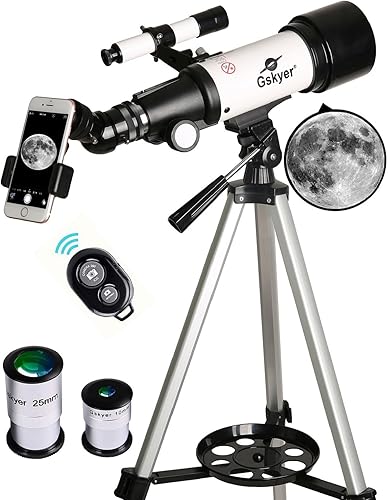
- 70 mm refractor with a 400 mm focal length
- Two eyepieces and a 3x Barlow lens
- Phone adapter and wireless remote
- Adjustable aluminum tripod and carrying bag
A simple 70 mm refractor with a phone adapter and a carry bag. Gskyer's kit gives a clear first look at the Moon at a low cost.
Pros
- Lightweight at 5.7 pounds
- Phone adapter and wireless remote included
- Gskyer says the optics are fully coated
Cons
- 70 mm shows less faint detail than the 80 mm picks
- No app guidance comes with the kit
Gskyer's 70 mm refractor is a simple first scope with a 400 mm focal length and an altazimuth mount. It comes with two eyepieces, a 3x Barlow lens, a phone adapter, a wireless remote and an aluminum tripod in a carrying bag.
The Moon and the brightest planets look sharp at moderate power. Faint targets stay faint, so set your expectations to the Moon and planets for the first few nights.
At 5.7 pounds, the kit is easy to carry from the house to the yard. Gskyer says the optics are fully coated for brighter views.
Best telescope under 200 dollars: what to buy first
Under 200 dollars, the first choice comes down to phone help, light and portability. Those three answers narrow the field faster than any spec sheet.
Best telescope under 200 for a first night
A simple start is a small refractor on an altazimuth mount. Point it, focus it and look, and the Moon and planets show well from the first night.
The StarSense LT 80AZ adds a plan for the sky, so the first session is guided from start to finish. If you want more light, the 127 mm PowerSeeker has the most aperture in this group, but its equatorial mount takes a few nights to learn.
Start the first night with a short list: the Moon, Jupiter, Saturn and one bright star cluster. Those four targets show up in almost every scope here, and they tell you whether you want to go bigger later.
What a budget telescope can and can't show
Budget scopes show the Moon with sharp craters and ridges. They show planets as small disks, with Jupiter's bands and Saturn's rings visible on steady nights.
They struggle with faint galaxies and nebulae. Expect those targets only from a darker site, and plan on a bigger aperture if they're your main goal.
Accessories change the feel of the view as much as the scope does. A steady tripod and a comfortable eyepiece make a first session easier, so check what comes in the box before you buy.
How to get the most from a budget telescope
Start with the Moon, and use a moderate eyepiece. Once you know how the focus and the mount feel, move on to planets and then to star clusters on a clear night.
Keep a simple notebook. Note the date, the target and what you saw, and you'll spot changes from night to night.
Join a local astronomy club or use a sky app's tonight list. Both teach the sky faster than trial and error does.
Eyepieces and Barlow lenses in budget kits
An eyepiece sets the magnification, and most budget kits come with two of them. A Barlow lens sits between the eyepiece and the tube and multiplies the power, often by two or three times.
Extra power isn't always better. A Barlow makes the image dimmer and shows more of the air's movement, so use it when the view is steady and the planet is high.
Keep the eyepieces clean and dry. A fingerprint on the lens shows up as a dim smudge on the planet, so hold eyepieces by the barrel and wipe them gently with a lens cloth.
The 127 mm PowerSeeker for a patient beginner
The PowerSeeker 127EQ has the most aperture of the five picks, at 127 mm. That extra light helps with planets, the Moon's craters and bright deep-sky targets like the Orion Nebula.
An equatorial mount rewards patience. Once you learn to line it up with the sky, it helps you follow targets as the sky turns, which suits a person who enjoys practice.
Which budget scope fits a small yard
A small yard or balcony favors the 70 mm Travel Scope or the Gskyer kit. Both are light enough to carry out and set up in a few minutes.
A larger yard or a permanent observing spot suits the 127 mm PowerSeeker. At 13 pounds, it's happier staying set up than going back in the closet every night.
How we picked these five
We ranked the picks on aperture, mount, what's in the box, phone help and how easy the scope is to carry. Aperture carries the most weight, because it decides how much light the scope can gather.
Side by side: five scopes under 200 dollars
Aperture is the biggest difference in this group. The 127 mm PowerSeeker gathers the most light, the two 80 mm scopes come next and the two 70 mm scopes are the smallest.
| Product | Best for | Aperture | Focal length | Mount | Our score |
|---|---|---|---|---|---|
| Celestron StarSense Explorer LT 80AZ | a phone-guided start | 80 mm | 400 mm | Altazimuth | 8.4 |
| Koolpte 80 mm AZ Refractor Kit | a complete starter kit | 80 mm | 600 mm | Altazimuth | 8.1 |
| Celestron Travel Scope 70 mm | travel and backpack use | 70 mm | 400 mm | Altazimuth | 8.0 |
| Celestron PowerSeeker 127EQ | the most light | 127 mm | 1000 mm | German equatorial | 7.7 |
| Gskyer 70 mm AZ Refractor | a first look at the Moon | 70 mm | 400 mm | Altazimuth | 7.5 |
Focal length tells you how the scope frames the sky, but it doesn't tell you how bright the view will be. Use aperture to compare brightness and focal length to think about magnification.
Which telescope under 200 dollars should you buy?
Pick the LT 80AZ if you want a phone to guide you to targets. Pick the Koolpte kit if you want a phone adapter, a remote and a bag in one box.
Pick the Travel Scope if the telescope has to fit in a backpack. Pick the PowerSeeker if you want the most light and don't mind learning an equatorial mount.
Pick the Gskyer if you want a simple first look at the Moon and planets.
What aperture does for a first scope
Aperture is the lens or mirror width. A 70 mm lens gathers less light than an 80 mm lens, and both gather much less than a 127 mm mirror.
More light helps with faint targets and planet detail. The bigger scope is also heavier, so the best size is the one you'll carry out on a clear night.
Why mount type matters
An altazimuth mount moves up and down and side to side, which is the easiest way for a beginner to aim. The PowerSeeker's equatorial mount lines up with the sky's axis, which takes practice.
If you're new to a mount, a simple altazimuth setup is the easier start. Our guide to refractor vs reflector telescopes explains how the optics differ.
What to skip under 200 dollars
Skip any scope that promises huge magnification. Power alone doesn't make a telescope better, and the air limits detail, so a moderate eyepiece often shows the most.
Skip kits with a thin tripod or no finder. A wobbly mount frustrates most first-time buyers more than a small aperture does.
Never point any of these scopes at the sun. This guide does not cover solar viewing.
The best telescope under 200 dollars is a first scope, not a final one
For most adults, the StarSense Explorer LT 80AZ is the easiest start, because the app helps you find the Moon and planets. If the phone isn't part of your plan, the Koolpte kit gives you the most gear for the money.
A first scope is for learning the sky. Once you know which targets you enjoy, read how to use a telescope on your first night and how to choose a telescope for beginners before you move up.
For the full picture across budgets, start with the telescope for adults guide.
If you're buying for someone else, the best telescope gifts for adults list covers the same kinds of scopes. To see what each price tier buys, read how much does a good telescope cost.
Our top 3 picks at a glance
-
1
Best for a phone-guided start
Celestron StarSense Explorer LT 80AZ
8.4/10 our score
See it on Amazon -
2
-
3
Frequently asked questions
Is a telescope under 200 dollars good enough for planets?
Yes, the 70 mm and 80 mm refractors show the Moon, Jupiter's cloud bands on steady nights and Saturn's rings as a small oval. The 127 mm reflector shows more detail but needs a bit more setup.
Which telescope under 200 dollars is best for a beginner?
For most adults, the StarSense Explorer LT 80AZ is the easiest start, because its app points you to targets. Pick the Koolpte kit if you want a phone adapter and a remote in the box.
Should I buy an equatorial mount under 200 dollars?
Only if you want the most light and you're willing to learn the mount. The PowerSeeker 127EQ is the one equatorial mount in this group, and an altazimuth mount is easier for a first scope.


