How Much Does a Good Telescope Cost?
A good telescope for a first look costs much less than a premium model, and the best value sits in the budget to mid-range tiers. Spend more only when you know what the extra light or mount will do for you.
On this page (10 sections)
- How much does a good telescope cost in each tier?
- What a budget telescope gets you
- What a mid-range telescope adds
- What premium telescopes add
- Hidden costs that catch first-time buyers
- How do you set a budget for a telescope?
- Spend on the parts you'll use most
- Signs a telescope is worth the money
- A cheap telescope isn't always a good one
- Where to start with a good telescope
How much does a good telescope cost? Budget scopes stay under 200 dollars, mid-range scopes run up to about 300 dollars, and the best value for a first telescope sits in those two tiers.
Spend more only when you know what the extra light or mount will do for you.
Most of the cost difference comes down to mirror size, mount and extras. Once you know which of those you need, the choice gets much simpler.
How much does a good telescope cost in each tier?
The budget and mid-range tiers give the best value for a first telescope. Budget scopes show the Moon and bright planets, and mid-range scopes add light for fainter targets.
Premium scopes cost more than the mid-range line. Those tiers match the caps in our roundups.
Premium scopes are worth it when you have a clear reason. They add bigger mirrors, sturdier mounts or computer guidance, and those upgrades matter once you know what you want to see.
What a budget telescope gets you
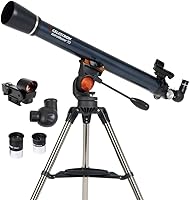
Budget scopes are usually small refractors, often 70 mm or 80 mm, on a simple altazimuth mount and a tripod. They show the Moon, planets and bright star clusters well.
Many budget kits include a phone adapter, a carrying bag and a finder scope. That keeps the first purchase complete, so you don't need to buy extras right away.
A budget kit with a phone adapter and a remote adds value, even though the adapter is for photos, not for finding targets.
What a mid-range telescope adds
Mid-range scopes add aperture. A 114 mm or 130 mm reflector gathers far more light than a 70 mm refractor, which helps with fainter objects like star clusters and the Orion Nebula.
Many mid-range models also add phone guidance or a tabletop base. The base keeps the setup simple, and the guidance helps you find targets without a long learning curve.
What premium telescopes add
Premium scopes add bigger mirrors, premium mounts and computer guidance. They suit a buyer who already knows the sky and wants more light and more control.
A premium scope is easy to overbuy for a first look at the sky. A mount you won't use, or a tube you can't carry, is money spent on the wrong thing.
Hidden costs that catch first-time buyers
The telescope is only part of the cost. Plan for eyepieces, a Barlow lens, a finder, a star chart or sky app, and a sturdier tripod if the first one wobbles.
A wobbly tripod frustrates more buyers than a small mirror does. If the scope shakes every time you touch the focuser, the upgrade is the tripod, not the optics.
Check the included parts before you buy. A kit with a finder, a diagonal and two eyepieces is a complete start, while a bare tube needs more gear.
How do you set a budget for a telescope?
Set your limit by where you'll observe and how often. A scope that stays in the closet is a waste, so choose one you'll carry out on a clear night.
How much a good telescope should cost you
If you want a list of picks that stay under a set cap, the best telescopes under 200 dollars guide does that job. It keeps the choices small and clear.
For the wider range of choices for adults, the best telescopes for adults roundup covers the next step up.
Spend on the parts you'll use most
The eyepiece is the part you touch most, but the mount affects every night. Aim for a steady mount first, then add eyepieces as you learn what you like.
A tripod that wobbles makes every view harder, so a sturdy tripod is worth more than an extra accessory. A finder that's easy to use speeds up every session.
Extra eyepieces matter once you know your favorite targets. Pick one or two that suit the scope's focal length, and skip the bundle of sizes you won't use.
Signs a telescope is worth the money
A worthwhile telescope has clear specs from the maker, a mount that holds steady when you touch the tube, and included parts that match its purpose. Those signs matter more than a long feature list.
A warranty helps too. A two-year warranty from a known maker gives you a safety net if the focuser or mount fails in the first year.
A cheap telescope isn't always a good one
A cheap scope with a stable mount and clear optics beats an expensive one with a shaky base. Look for a known brand, a steady mount and a finder you can use.
A good telescope costs what you'll actually use. Buy the scope that fits your space, your carrying plans and the sky you want to see first.
Where to start with a good telescope
How much a good telescope costs matters less than whether it fits your life. Start with the telescope for adults guide, which explains how the price tiers line up with the kinds of scopes on the market.
Before you buy, read how to choose a telescope for beginners. It walks through the questions that matter most, and how to use a telescope on your first night covers what to do once it arrives.
Frequently asked questions
Is a cheap telescope worth buying?
Yes, if it's from a known brand with a steady mount. A small 70 mm or 80 mm refractor shows the Moon and bright planets well, but a wobbly tripod frustrates more first-time buyers than a small mirror does.
How much should I spend on a first telescope?
Most first-time buyers do well in the budget to mid-range tiers. Spend more only when you know you'll use the extra light, a computer mount or an app that fits your plans.
Are expensive telescopes better for beginners?
Not always. A premium scope with a complex mount can be harder to use than a simple tabletop Dobsonian with a bigger mirror, so the right fit matters more than the price tier.