How to Choose a Telescope for Beginners
Choose a telescope for beginners by looking at four things in order: what you want to see, the mount, the aperture and how much setup you can handle. For most first buyers, a 114 mm to 130 mm reflector on a simple mount is the balance to aim for.
On this page (12 sections)
- Start with what you want to see
- How much aperture do you need?
- Which mount suits a first telescope?
- Refractor or reflector for a first scope?
- Should you get an app-guided telescope?
- Which accessories to check before you buy
- How much should a first telescope cost?
- What to check when the box arrives
- A simple plan before you buy
- Products to look at first
- Safety before your first night
- How to choose a telescope for beginners: the short version
Choose a telescope for beginners by working through four things in order: what you want to see, the mount, the aperture and how much setup you can handle. Most first buyers end up happiest with a 114 mm to 130 mm reflector on a simple mount, though the right choice depends on what you want to see first.
This guide walks through each decision in plain terms. It gives you the questions to answer before you compare models, and a few products to look at first.
If you want picks rather than a checklist, read the best beginner telescopes for adults. If you want the full overview of scope types, start with the Telescopes for Adults guide.
Start with what you want to see
Your first telescope should match your first targets. For most beginners, those targets are the Moon, the brighter planets and a few bright star clusters.
Deep-sky targets, such as galaxies and nebulae, are a later step. They look faint and small through most beginner scopes, so don't buy a scope based only on those pictures.
What a first telescope shows well
A beginner telescope shows the Moon in sharp detail, with craters and mountain edges visible on most nights. It also shows Jupiter and Saturn, and it can show bright star clusters from a dark site.
Those views are enough for a first year of observing. The Moon and planets can keep you busy for a long time before you need anything else.
What's harder from a first scope
Faint galaxies and nebulae look small and soft through most beginner telescopes. Many buyers expect the bright, colorful pictures from magazines, and a first scope usually won't match them.
Set that expectation before you buy, and you'll enjoy the first scope more. The views are real, but they're quieter than the photos.
How much aperture do you need?
Aperture is the diameter of the telescope's main lens or mirror, and it decides how much light the scope gathers. More aperture gives brighter views and more detail on planets, as long as the air is steady.
A 114 mm to 130 mm scope is a common first size. A 70 mm scope still works, but its views are smaller and dimmer than the bigger scopes.
Why aperture beats magnification
A telescope box often lists a high magnification number. That number depends on the eyepiece, so it says little about the view.
Aperture is the better guide. A bigger lens or mirror shows finer detail and brighter targets at normal powers, which is what most first-timers want.
Why 70 mm is the smallest sensible start
A 70 mm scope is the smallest size that still shows the Moon and planets well. Below that, the view gets small and dim, and most buyers find it frustrating.
If the budget is tight, a 70 mm scope is still a fair start. Plan to upgrade to a bigger aperture once you know what you enjoy.
Which mount suits a first telescope?
The mount decides how the scope moves and how easy it is to aim. For a first telescope, an altazimuth base or a Dobsonian base is the simplest choice.
An equatorial mount rewards patience. It takes practice, so it's better as a second scope than as a first one for most adults.
Altazimuth mounts
An altazimuth mount moves up and down and side to side. You aim it by hand, and the motion is intuitive, which makes it a good first choice.
Many app-guided scopes use an altazimuth base, since the app works best with a mount that moves in two simple directions.
Dobsonian bases
A Dobsonian is an altazimuth telescope on a plain box base. It's often the cheapest way to get a large aperture, and it's simple to aim once you get the feel for it.
A tabletop Dobsonian suits a sturdy table, which keeps the scope off the ground. A floor Dobsonian needs a flat, firm spot outside.
A beginner telescope on an equatorial mount
An equatorial mount lines up with Earth's axis. Once aligned, one knob follows the sky, which makes tracking planets easier.
The trade-off is the setup time and the learning curve. A first-timer may need several evenings before the mount feels easy.
Refractor or reflector for a first scope?
A refractor uses a lens, and a reflector uses a mirror. Both can give a good first view, but they trade off size, cost and upkeep in different ways.
For a closer comparison, read refractor vs reflector telescope before you decide.
What a refractor does well
A refractor has a sealed tube, so there's no mirror to line up. It's quick to start and easy to store, which suits a buyer who wants to skip the upkeep.
Cheaper refractors can show a faint color fringe around very bright objects, such as Jupiter. That's a small trade-off for a simple scope.
What a reflector does well
A reflector gives more aperture for its size, so a 114 mm or 130 mm reflector often beats a refractor of the same size. The open tube also means the scope needs a few minutes to reach outside temperature.
Reflectors may need their mirrors lined up now and then. That's a simple task once you know how.
Should you get an app-guided telescope?
An app-guided telescope is a good choice if you want help finding targets. A phone app points you to a list of objects for the night and shows arrows to guide you.
If you'd rather learn the sky by hand, a scope without an app is still a fine first choice. Many adults enjoy the learning curve as much as the views.
What the app does
An app-guided scope uses your phone to read the stars overhead and show you where to point. The app can also list what's up that night, which helps when you don't know where to start.
For a closer look at how these scopes work, read how to use Celestron StarSense. It walks through the setup and the first night.
What it needs
The app needs a clear sky and a phone that fits the dock. Cloudy nights and tall buildings make it harder to use, so plan a backup activity for those nights.
Which accessories to check before you buy
A first telescope should come with an eyepiece, a finder and a stable mount or base. Check those three before you compare models on price or aperture.
A Barlow lens is a useful extra, but it's not essential on the first night. Add it later once you know which views you want more of.
Eyepieces
Most beginner scopes include two eyepieces, with different powers. A lower-power eyepiece gives the widest view, while a higher-power one shows more detail on a steady night.
If the scope includes only one eyepiece, plan to add a second early on. Two eyepieces cover most of what a first-timer needs.
Finder
A finder helps you aim the scope before you look through the eyepiece. A red dot finder or a StarPointer is common on beginner scopes.
Check that the finder is included and that it's easy to adjust. A finder that's out of line is one of the most common reasons for a missed target.
How much should a first telescope cost?
Plan for a scope in the budget or mid-range tier, rather than the cheapest tiny scope on the shelf. Very small scopes often frustrate first-timers because the views are dim and the mounts wobble.
Our how much does a good telescope cost guide explains the tiers in plain terms, and the best telescopes under 300 dollars lists picks that stay within a clear budget.
What to check when the box arrives
Check the box against the manual before you try to observe. A missing eyepiece or finder is much easier to sort out in the first week than on a cold night.
Eyepieces and finder
Look at each eyepiece for dust or scratches, and make sure it slides into the focuser without wobbling. Check that the finder is attached and that its dot or crosshair is easy to adjust.
Mount and tripod
Set the base or tripod up on a flat surface, and tighten each knob by hand. A loose knob or a wobbly leg shakes the view, which makes a planet hard to hold.
Keep the manual with the scope. Settings and steps are easy to forget, and the manual is the first place to check when something seems wrong.
A simple plan before you buy
Work through these steps in order, and you'll have a short list before you open a single product page. Each step narrows the field, so you don't have to compare every model on the market.
Start by writing down the first three targets you want to see, such as the Moon, Jupiter and Saturn. That list tells you which aperture and mount you need, and it rules out scopes that can't show those targets well.
Next, decide where you'll set up. A tabletop scope needs a sturdy table, while a tripod scope needs a level patch of ground, so the spot you pick narrows the choice before the spec sheet does.
Then decide how much setup you'll accept on a weeknight. If the answer is a few minutes, choose an altazimuth or Dobsonian base, and if you enjoy the learning curve, an equatorial mount is worth a look.
Finally, check the box for eyepieces, a finder and a steady base. A scope that meets these checks is a safe first buy, and the rest comes down to taste.
The best telescopes for adults roundup applies these checks to five scopes, so it's a good next read.
Products to look at first
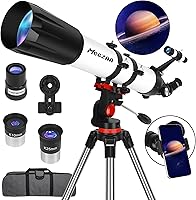
Three scopes show the main choices in this guide. Each one suits a different buyer, so compare them against what you want to see first.
Safety before your first night
Never point a telescope at the sun unless it has a certified solar filter made for that model. Looking at the sun through an unfiltered telescope can cause permanent eye damage, and clip-on or improvised filters are not safe.
Keep the first targets to the Moon, planets and stars, and read the instructions before your first night. A few minutes of reading saves a lot of frustration later.
How to choose a telescope for beginners: the short version
Start with what you want to see, then pick the aperture and mount that fit those targets. Check the box for the eyepieces and finder, and make sure you have room for the scope.
Most adults do well with a 114 mm to 130 mm scope on an altazimuth or Dobsonian base. Add an app if you want help, or skip it if you'd rather learn the sky by hand.
For a first-night walk-through, read how to use a telescope. It covers setup, aiming and focusing in plain steps.
Frequently asked questions
What size and mount should a first telescope have?
A 114 mm to 130 mm scope on an altazimuth or Dobsonian base is a strong starting point for most adults. It shows the Moon and planets clearly, and the simple mount is easy to aim, so the scope gets used more often.
Should a beginner buy a refractor or a reflector?
Either works for a first telescope, and the choice depends on what you value. A refractor has a sealed tube and little upkeep, while a reflector gives more aperture for its size and may need its mirrors lined up now and then.
Is a telescope with a high magnification number better?
Not necessarily, because magnification depends mostly on the eyepiece you use. Aperture decides how much detail you can see, so a scope with a modest magnification number and a bigger aperture usually gives a better first view on most nights.
How much room does a first telescope need?
A tabletop Dobsonian needs a sturdy table, while a tripod scope needs a level patch of ground or floor. Measure the spot, and leave room around the scope for the tube to swing while you aim it by hand before you buy.