5 Best Beginner Telescopes for Adults (October 2026)
The best beginner telescopes for adults include the Celestron StarSense Explorer LT 114AZ for a beginner who wants guided targets, the Sky-Watcher Heritage 130 Tabletop Dobsonian for a ready-to-use tabletop, and the Koolpte 80 mm 600 mm Refractor for a budget refractor with a phone adapter.
On this page (9 sections)
- The best beginner telescopes for adults in detail
- Side by side: setup, mount and aperture for beginners
- How we picked these five beginner telescopes
- Which beginner scope fits your first month
- Common first-night mistakes
- Learning the sky with a beginner telescope
- What a first month with a beginner telescope looks like
- Safety for a first telescope
- Choosing the best beginner telescope for adults
The best beginner telescope for adults is the Celestron StarSense Explorer LT 114AZ, because its app points you to targets on the first night. This list ranks five scopes on how quickly they go from box to backyard and how much they help a first-timer learn the sky.
We compared each scope on setup steps, mount type, what the box includes and how much aperture it gives. We also looked at how much the scope asks you to know before you can find anything.
The first-night steps are the same for most scopes. If you want the full walk-through, read how to use a telescope before you open the box.
Our picks at a glance
-
1
 Best for a beginner who wants guided targets
Celestron StarSense Explorer LT 114AZ
8.7/10 our score
See it on Amazon -
2
 Best for a ready-to-use tabletop
Sky-Watcher Heritage 130 Tabletop Dobsonian
8.4/10 our score
See it on Amazon -
3
 Best for a budget refractor with a phone adapter
Koolpte 80 mm 600 mm Refractor
8.1/10 our score
See it on Amazon
- 4
 Check it
Celestron Travel Scope 70 Portable Telescope
Best for trips with a backpack - 5
 Best for a refractor kit with a tripod and bagCheck it
The best beginner telescopes for adults in detail
The Celestron StarSense Explorer LT 114AZ suits a beginner who would rather be guided than learn the sky first. The app uses your phone to read the stars overhead, then shows the targets worth seeing that night.
Celestron StarSense Explorer LT 114AZ
- 114 mm Newtonian reflector
- Phone app guides you to targets
- Preassembled altazimuth mount and tripod
- 25 mm and 10 mm eyepieces and a 2x Barlow
For a beginner who would rather be guided than learn the sky first, the app points to a short list of targets for the night.
Pros
- App gives a short list of targets for your time and location
- Mount and tripod arrive preassembled
- Two-year US warranty from Celestron
Cons
- Needs a phone and a clear sky for the app to work
- Less aperture than the Heritage 130
Celestron says the mount and tripod arrive preassembled, so the first job is docking your phone and following the arrows. The kit includes 25 mm and 10 mm eyepieces, a 2x Barlow lens and a StarPointer finder.
The app needs a clear sky and a phone that fits the dock. Keep a plan for cloudy nights, such as a few Moon and planet notes to read through when the sky clears.
Celestron backs the scope with a two-year US warranty. For a beginner who wants guidance, that's the main reason to pick this model over the others here.
Sky-Watcher Heritage 130 Tabletop Dobsonian
- 130 mm reflector
- 650 mm focal length
- Arrives fully assembled
- Two-year warranty
The fastest route from box to first view, with a large mirror on a simple base and no equatorial mount to learn.
Pros
- Ready to use out of the box
- Simple base you aim by hand
- Two-year warranty from Sky-Watcher
Cons
- Only two eyepieces in the box
- Observing from a table suits some beginners better than others
The Sky-Watcher Heritage 130 suits a beginner who wants a large mirror and no assembly. It arrives fully assembled, so the first job is to set it on a steady table and fit the eyepiece.
A 130 mm mirror is a good size for the Moon and the brighter planets. With the 25 mm eyepiece the power stays modest, which makes for a comfortable first view.
You observe from a seat or while standing at the table, so check the height before you buy. A table that's too low makes the eyepiece awkward to reach for a long session.
Sky-Watcher gives the scope a two-year warranty. Only two eyepieces come in the box, so add a third eyepiece or a Barlow once you know what you like to see.
Koolpte 80 mm 600 mm Refractor
- 80 mm refractor
- 600 mm focal length
- Altazimuth (AZ) mount
- 25 mm and 10 mm eyepieces, a 3x Barlow, phone adapter and wireless remote
A simple altazimuth refractor with a phone adapter and a remote, for a beginner who wants a modest first step.
Pros
- Altazimuth mount is simple to aim
- Phone adapter and wireless remote are in the box
- Carry bag makes it easy to store
Cons
- Smaller aperture than the 114 mm and 130 mm scopes
- The finder needs a few minutes of alignment
The Koolpte 80 mm suits a beginner who wants an altazimuth refractor with a phone adapter and a remote in the box. Its 80 mm lens and 600 mm focal length give bright, clear views of the Moon and planets.
The box includes 25 mm and 10 mm eyepieces, a 3x Barlow, a phone adapter, a wireless remote and a carry bag. Koolpte says no tools are needed for setup, and the aluminum tripod is the piece you'll adjust most.
The finder is a 5x24 model, so take a few minutes to line it up before the first night. A bright star near the Moon or a planet makes a good test target for lining it up.
It's a modest first step, with less aperture than the 114 mm and 130 mm scopes. For many beginners, the simple altazimuth mount and the included accessories make up for it.
Celestron Travel Scope 70 Portable Telescope
- 70 mm refractor
- 400 mm focal length
- Tripod and tube pack into a backpack
- 20 mm and 10 mm eyepieces
The lightest route to a first view for a beginner who wants to take the scope away from home.
Pros
- Packs into a backpack with its tripod
- Celestron says setup takes minutes with no tools
- Works for daytime land views too
Cons
- Smallest aperture in this roundup
- Fainter objects look dimmer than through the bigger scopes
The Celestron Travel Scope 70 suits a beginner who wants to take the scope on trips. It's a 70 mm refractor with a 400 mm focal length, and the tripod and tube pack into a backpack.
Celestron says it sets up in minutes and needs no tools. The kit includes 20 mm and 10 mm eyepieces, and the scope works for daytime views of land and wildlife as well as the night sky.
Its smaller lens means faint objects look dimmer than they do through the 114 mm or 130 mm scopes. It's best for the Moon and the brightest planets, rather than fainter targets.
The Travel Scope suits a beginner who values portability above everything else, and it's the easiest of the five to put back in a bag after a session.
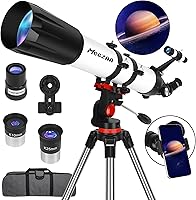
MEEZAA 90 mm 800 mm Refractor
- 90 mm refractor
- 800 mm focal length
- 10 mm and 25 mm eyepieces with a 3x Barlow
- Phone adapter, carry bag and adjustable tripod
A complete kit in one bag, with a sealed refractor tube that never needs its mirrors lined up.
Pros
- Complete kit in a carry bag
- No mirror to align before you start
- Tripod adjusts to a comfortable height
Cons
- Less aperture than the 114 mm and 130 mm reflectors
- Some color fringing on the brightest objects
The MEEZAA 90 suits a beginner who wants a complete refractor kit in one bag. The box includes two eyepieces, a 3x Barlow, a phone adapter, an adjustable stainless steel tripod and the carry bag.
A refractor has a sealed tube, so there are no mirrors to line up before the first night. Its 800 mm focal length gives a long, narrow view that works well on the Moon.
The tripod adjusts from 28 to 46 inches, which helps you find a comfortable height whether you're sitting or standing. The 90 mm lens is the largest refractor aperture in this roundup, though it still sits below the reflectors.
Expect some color fringing on the brightest objects. For a beginner, it's a small price for a scope that's quick to set up and simple to carry.
Side by side: setup, mount and aperture for beginners
The five beginner picks run from 70 mm to 130 mm of aperture. The mount and the setup steps change the first-night experience as much as the aperture does, so the table shows both.
| Product | Best for | Aperture | Focal length | Mount | Our score |
|---|---|---|---|---|---|
| Celestron StarSense Explorer LT 114AZ | a beginner who wants guided targets | 114 mm | 1000 mm | Altazimuth | 8.7 |
| Sky-Watcher Heritage 130 Tabletop Dobsonian | a ready-to-use tabletop | 130 mm | 650 mm | Tabletop Dobsonian | 8.4 |
| Koolpte 80 mm 600 mm Refractor | a budget refractor with a phone adapter | 80 mm | 600 mm | Altazimuth | 8.1 |
| Celestron Travel Scope 70 Portable Telescope | trips with a backpack | 70 mm | 400 mm | Altazimuth | 8.0 |
| MEEZAA 90 mm 800 mm Refractor | a refractor kit with a tripod and bag | 90 mm | 800 mm | Altazimuth | 7.7 |
The LT 114AZ and the Heritage 130 need the fewest decisions before the first view. The MEEZAA 90 and the Koolpte 80 ask you to set up a tripod and align a finder, while the Travel Scope 70 trades aperture for the easiest trip.
How we picked these five beginner telescopes
We compared the specs, features and setup notes for each scope. Then we asked what a first-time adult buyer needs to see the Moon and planets within the first week.
Four things decided the order:
- How many steps does it take to go from the box to the first view?
- Is the mount simple to aim, or does it take practice?
- What does the box include, such as eyepieces, a finder and a tripod?
- How much light does the aperture gather for the targets a beginner wants first?
Our score weighs specs, features and buyer feedback against what you're shopping for. Scores in this roundup run from 7.7 to 8.7, and each one reflects that trade-off.
Which beginner scope fits your first month
Start with the LT 114AZ if you want the app to point you at targets while you learn. Start with the Heritage 130 if you want a larger mirror and no phone in the process.
Choose the MEEZAA 90 if you want a complete kit and a tripod that adjusts for a comfortable view. Pick the Koolpte 80 or the Travel Scope 70 if the budget and portability matter more than aperture.
A beginner telescope for adults with guidance
The LT 114AZ is the only scope in this list that comes with an app. It helps most when you have a clear sky and a few minutes to dock your phone and follow the arrows.
If you want a portable kit
The Travel Scope 70 and the MEEZAA 90 both pack down into a bag. The Travel Scope is the lighter route, while the MEEZAA adds a Barlow lens and a phone adapter to the bag.
Common first-night mistakes
Most first-night frustration comes from too much power, a wobbly base or a finder that isn't lined up. Each of these is easy to fix once you know to check for it.
Starting at high power
A beginner's first instinct is to use the highest power the box allows. The image gets dimmer and softer as the power climbs, so start with the lowest-power eyepiece and move up only when the view is steady.
A wobbly base
A telescope on a table that rocks makes every target shake. Set the base on a firm, level surface, and let the scope sit still for a minute before you look.
A finder that isn't lined up
If the target is in the finder but not in the eyepiece, the finder needs adjusting, so center a bright star in the eyepiece first. Then nudge the finder until that same star sits in the middle of its dot or crosshair.
For a planet-specific walk-through, see how to find planets with a telescope.
Dew and cold on the lens
On a cool, damp night, dew can form on the lens or the mirror and blur the view. Keep the dust caps on until you're ready to observe, and wipe the optics gently with a soft cloth if dew settles on them.
A scope that's cold can also make the image wobble, so give it a few minutes outside before you judge the view.
Learning the sky with a beginner telescope
Start with the Moon, since it's bright and easy to find on almost any night. Then move to Jupiter and Saturn, which are the planets most adults want to see first.
After the planets, try bright star clusters and the brightest double stars. For a longer list of what a first telescope can show, read what you can see with a telescope.
What a first month with a beginner telescope looks like
Plan the first month around a few short sessions rather than one long one. Short sessions keep the scope in use, and they teach you the setup steps before you need them on a cold night.
Week one: the Moon and bright stars
Use the first clear night to learn the setup and the finder. Start with the Moon, since it's bright enough to show you whether the focus and the aim are right.
Once the Moon looks sharp, try a bright star cluster on a clear night. Clusters are easy to find, and they show whether your eyes and the scope are ready for fainter targets later.
Week two: planets and a finder
By the second week, move to Jupiter or Saturn if either is up. Use the finder to aim and the lowest-power eyepiece to center the planet, then step up only if the view is steady.
Keep a short note of what you saw and when. A few lines in a notebook make it easier to find the same target again, and they show how much you've learned in a month.
Safety for a first telescope
Never point a telescope at the sun unless it has a certified solar filter made for that model. Looking at the sun through an unfiltered telescope can cause permanent eye damage, so keep the scope's first targets to the Moon, planets and stars.
The same goes for daytime land views through the Travel Scope or any other model here. Check that the tube and its finder aren't aimed near the sun before you look.
Choosing the best beginner telescope for adults
If you want the easiest first step, the Celestron StarSense Explorer LT 114AZ is the pick. The app gives a beginner adult a target list and a way to find it.
If you want a larger mirror with no assembly, the Sky-Watcher Heritage 130 is the best beginner telescope for an adult who has a steady table. Choose the MEEZAA 90, the Koolpte 80 or the Travel Scope 70 if the kit, the price or the portability matters most.
Before you buy, read the how to choose a telescope for beginners guide for a full checklist.
If you're buying for someone else, see the best telescope gifts for adults.
Our top 3 picks at a glance
-
1
Best for a beginner who wants guided targets
Celestron StarSense Explorer LT 114AZ
8.7/10 our score
See it on Amazon -
2
Best for a ready-to-use tabletop
Sky-Watcher Heritage 130 Tabletop Dobsonian
8.4/10 our score
See it on Amazon -
3
Best for a budget refractor with a phone adapter
Koolpte 80 mm 600 mm Refractor
8.1/10 our score
See it on Amazon
Frequently asked questions
What is the easiest telescope for an adult beginner?
The easiest scopes to start with arrive assembled and sit on a simple altazimuth or Dobsonian base. The Heritage 130 comes fully assembled, and the LT 114AZ adds a phone app that points you to targets, which helps most on a first night.
Should a beginner adult start with a refractor or a reflector?
Both suit a first night, so pick the trade-off you prefer. A refractor has a sealed tube and little upkeep, while a reflector gives more aperture for the size and may need its mirrors lined up now and then, a simple task once you know how.
Do I need a Barlow lens as a beginner?
A Barlow lens isn't needed on the first night, since most beginners start with the eyepieces in the box. A Barlow multiplies the power of each eyepiece, but the image gets dimmer and softer as the power climbs, so add one later when you know which views you want more of.
Is a phone app worth it for a first telescope?
It can be, if the app helps you find things you'd otherwise miss on a clear night. The LT 114AZ is the only app-guided scope in this roundup, and it needs a clear sky and a phone that fits the dock to work well.