5 Best Telescopes for Adults (October 2026)
The best telescopes for adults include the Celestron StarSense Explorer LT 114AZ for a guided first night, the Sky-Watcher Heritage 150 Tabletop Dobsonian for the most aperture on a table, and the Sky-Watcher Heritage 130 Tabletop Dobsonian for a no-fuss tabletop setup.
On this page (12 sections)
- The best telescopes for adults, in detail
- Side by side: the best telescopes for adults by aperture and mount
- How we picked these five telescopes
- What to check in the box before you leave
- What aperture and mount mean for an adult's first telescope
- What an adult can see on the first night
- Which telescope fits which adult
- Who this roundup isn't for
- Tube types at a glance
- What to ask before you buy an adult telescope
- Safety first
- Choosing the best telescope for adults
The best telescope for adults on this list is the Celestron StarSense Explorer LT 114AZ, because its app finds targets for you. This list covers five scopes that suit a first real telescope, from a phone-guided reflector to tabletop Dobsonians.
We compared each scope on aperture, mount type, eyepieces and setup effort. We also checked what comes in the box, because a missing eyepiece or finder can change the whole first night.
If you're still choosing a type, read the Telescopes for Adults guide first. It explains the main types in plain terms.
Our picks at a glance
-
1
 Best for a guided first night
Celestron StarSense Explorer LT 114AZ
8.7/10 our score
See it on Amazon -
2
 Best for the most aperture on a table
Sky-Watcher Heritage 150 Tabletop Dobsonian
8.5/10 our score
See it on Amazon -
3
 Best for a no-fuss tabletop setup
Sky-Watcher Heritage 130 Tabletop Dobsonian
8.4/10 our score
See it on Amazon
The best telescopes for adults, in detail
The Celestron StarSense Explorer LT 114AZ comes first because its app does most of the finding. You dock your phone, open the app and follow the on-screen arrows until the bullseye turns green.
Celestron StarSense Explorer LT 114AZ
- 114 mm Newtonian reflector
- Phone app guides you to targets
- Altazimuth mount
- 25 mm and 10 mm eyepieces and a 2x Barlow
The app does the hunting, so an adult with no star-finding experience can locate planets and bright clusters on the first night.
Pros
- Phone app guides you to targets
- Altazimuth mount is simple to aim
- Two-year US warranty from Celestron
Cons
- Needs a phone and a clear view of the sky for the app
- Smallest aperture of the four reflectors here
The LT 114AZ is a 114 mm Newtonian reflector on an altazimuth mount. It moves up, down and side to side with no polar alignment, so you can start observing soon after you unpack it.
The app builds a short list of targets for your time and location. That helps when you don't yet know what's up, or where to look first.
Celestron says the view is sharp and vivid on the Moon, on planets like Jupiter and Saturn, and on bright deep-sky objects such as the Orion Nebula.
The box includes 25 mm and 10 mm eyepieces, a 2x Barlow lens and a StarPointer finder. Celestron backs the scope with a two-year US warranty.
The app needs a clear view of the sky and a phone that fits the dock. A backyard or a dark park suits it best.
Sky-Watcher Heritage 150 Tabletop Dobsonian
- 150 mm reflector
- 750 mm focal length, f/5
- Tabletop Dobsonian base with rubber feet
- Collapsible tube
The widest aperture in this roundup on a simple box base, for an adult with a sturdy table and room to move the tube.
Pros
- Most light gathered in this roundup
- Simple base that you aim by hand
- Tube folds for storage
Cons
- Needs a sturdy table and room around it
- Costs more than the other picks here
The Sky-Watcher Heritage 150 is the largest scope in this roundup, with 150 mm of aperture and a 750 mm focal length. It's a tabletop Dobsonian, so a simple box base holds the tube and you aim it by hand.
Sky-Watcher says the rubber feet cut down on vibration, and that the collapsible tube keeps its collimation when folded. It's the premium pick here, and it suits an adult who wants the most light and has a sturdy table.
A 150 mm mirror gathers more light than the 114 mm and 130 mm scopes, which helps on the Moon and planets. The trade-off is space, since you need a stable table and room to move the tube from side to side.
Sky-Watcher Heritage 130 Tabletop Dobsonian
- 130 mm reflector
- 650 mm focal length
- Arrives fully assembled
- 10 mm and 25 mm eyepieces and a StarPointer finder
A 130 mm tabletop Dobsonian that is ready to use out of the box, with a two-year warranty and no equatorial mount to learn.
Pros
- Arrives fully assembled
- Simple base with no mount to learn
- Two-year warranty from Sky-Watcher
Cons
- Only two eyepieces come in the box
- You observe from a table, which some adults find awkward
The Sky-Watcher Heritage 130 is a 130 mm tabletop Dobsonian with a 650 mm focal length. It arrives fully assembled, with 10 mm and 25 mm eyepieces and a StarPointer finder in the box.
It's a good fit for an adult who wants a large aperture without learning an equatorial mount. Sky-Watcher calls it easy to transport, and the base and tube come as one package.
Because it sits on a table, you'll observe from a chair or while standing at the table. That's comfortable for some adults and awkward for others, so check your table height before you buy.
Sky-Watcher gives it a two-year warranty. Only two eyepieces come in the box, so plan on a Barlow lens or a third eyepiece if you want more power later.
MEEZAA 90 mm 800 mm Refractor

- 90 mm refractor
- 800 mm focal length
- 10 mm and 25 mm eyepieces with a 3x Barlow
- Phone adapter, carry bag and adjustable tripod
A refractor kit with a sealed tube, a tripod and a carry bag, for an adult who wants a portable scope with no mirror to line up.
Pros
- Sealed refractor tube with no mirror to align
- Carry bag holds the tube and accessories
- Phone adapter is in the box
Cons
- Smallest aperture in this roundup
- Expect some color fringing around bright objects
The MEEZAA 90 mm refractor has an 800 mm focal length and a full set of starter parts. The box includes a 10 mm and a 25 mm eyepiece, a 3x Barlow lens, a phone adapter, a carry bag and an adjustable stainless steel tripod that stretches from 28 to 46 inches.
A refractor uses a lens and a sealed tube, so there's no mirror to line up. That makes it quick to start and low on upkeep, which suits an adult who wants a simple scope.
The 90 mm lens gathers more light than a 70 mm scope, so bright targets look brighter. The carry bag keeps the tube, eyepieces and accessories together for a quick trip out to the yard.
Cheaper refractors can show a faint color fringe around very bright objects, such as Jupiter. Expect some fringing on the brightest targets, and don't count on a perfectly clean edge.
Celestron AstroMaster 130EQ
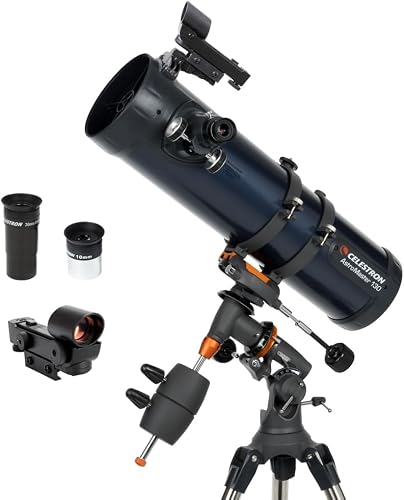
- 130 mm Newtonian reflector
- German equatorial mount
- Slow-motion control knobs
- 20 mm and 10 mm eyepieces and a StarPointer
Good aperture on an equatorial mount with slow-motion knobs, for an adult who is ready to learn how the mount works.
Pros
- 130 mm aperture with slow-motion knobs
- Two-year US warranty from Celestron
- Built-in StarPointer finder
Cons
- Equatorial mount takes practice to set up
- Harder to aim quickly than an altazimuth base
The Celestron AstroMaster 130EQ is a 130 mm Newtonian reflector on a German equatorial mount, with a 650 mm focal length. It offers more aperture than the 114 mm scope, but it asks for a steeper learning curve.
Celestron says the two slow-motion knobs, one for right ascension and one for declination, make it smooth to aim at planets and deep-sky objects. The box includes a 20 mm eyepiece with a built-in erect image corrector, a 10 mm eyepiece and a built-in StarPointer finder.
An equatorial mount takes practice. You line the mount up with the sky, then turn the knobs as the stars drift, which is more work than an altazimuth base.
Celestron backs the scope with a two-year US warranty. For an adult who wants to learn the sky step by step, the mount is part of the fun.
Side by side: the best telescopes for adults by aperture and mount
The five picks run from 90 mm to 150 mm of aperture. Mount type matters as much as size, so the table shows both.
| Product | Best for | Aperture | Focal length | Mount | Our score |
|---|---|---|---|---|---|
| Celestron StarSense Explorer LT 114AZ | a guided first night | 114 mm | 1000 mm | Altazimuth | 8.7 |
| Sky-Watcher Heritage 150 Tabletop Dobsonian | the most aperture on a table | 150 mm | 750 mm | Tabletop Dobsonian | 8.5 |
| Sky-Watcher Heritage 130 Tabletop Dobsonian | a no-fuss tabletop setup | 130 mm | 650 mm | Tabletop Dobsonian | 8.4 |
| MEEZAA 90 mm 800 mm Refractor | a refractor with a bag and tripod | 90 mm | 800 mm | Altazimuth on a tripod | 7.7 |
| Celestron AstroMaster 130EQ | learning an equatorial mount | 130 mm | 650 mm | German equatorial | 7.3 |
The two Dobsonians and the app-guided LT 114AZ are the simplest to aim. The AstroMaster 130EQ asks for the most practice, and the MEEZAA 90 has the smallest aperture but the most parts in the box.
How we picked these five telescopes
We compared the specs, features and setup notes for each scope. Then we checked how well it suits an adult buying a first telescope, rather than a child or a dedicated astronomer.
Four questions decided the order:
- How much aperture does it have, and how much light does that gather?
- What kind of mount is it, and how much practice does the mount need?
- What does the box include, such as eyepieces, a finder and a tripod?
- How much help does it give you on a first night?
Our score weighs specs, features and buyer feedback against what you're shopping for. Scores in this roundup run from 7.3 to 8.7, so no pick suits every adult.
What to check in the box before you leave
A first telescope is only as useful as its parts. Before you start, confirm the eyepieces, the finder and the tripod or base are all there and in working order.
Check the eyepiece barrel size too. Many scopes in this price range use 1.25 inch eyepieces, the most common size, and a 2x or 3x Barlow lens usually fits the same barrel.
Read the how to choose a telescope for beginners guide for a longer checklist, including what to look for in a mount.
What aperture and mount mean for an adult's first telescope
Aperture is the most useful number on a telescope spec sheet, but the mount decides whether you'll use the scope at all. Pick a size you can carry and a mount you can aim without frustration.
Why aperture matters more than magnification
Magnification is easy to advertise and hard to use well. A bigger lens or mirror gathers more light, so the Moon and planets look sharper at normal powers.
Higher magnification only enlarges what the aperture already gathered. Past a point, the image gets dimmer and softer, and the air above you usually limits the detail before the eyepiece does.
Telescope mounts that suit adults
An altazimuth mount moves up and down and side to side, so it's the simplest for a first night. A Dobsonian is an altazimuth telescope on a plain box base, and it suits a table or a low stand.
An equatorial mount lines up with Earth's axis and rewards patience. For a closer look at tube types, read refractor vs reflector telescope and what a Dobsonian telescope is.
What an adult can see on the first night
With any of these five scopes, the Moon looks sharp, and the craters along its edge are the first thing most adults notice. Give your eyes a few minutes to adjust before you judge the view.
Jupiter's cloud bands show up when the air is steady, and Saturn's rings appear as a clear oval even in the smaller scopes on this list. Bright star clusters look good from a dark sky, while faint galaxies and nebulae look small and soft.
Planets are the most rewarding first targets. For a step-by-step guide to locating them, see how to find planets with a telescope.
Which telescope fits which adult
Pick the LT 114AZ if you want the app to find targets for you. Pick a Heritage Dobsonian if you want a big aperture on a simple base and you have a steady table.
Choose the MEEZAA 90 if you want a refractor kit with a tripod and bag that's easy to carry outside. Choose the AstroMaster 130EQ only if you're happy to learn an equatorial mount and turn the knobs as the sky moves.
Who this roundup isn't for
Each scope here is a manual telescope, with no motor and no built-in tracking. If you want to photograph the sky, you'll need a mount that tracks on its own, and that's a different class of gear.
If you're shopping for someone else, our best telescope gifts for adults list is a better starting point. To see what each price tier buys, read how much does a good telescope cost.
Tube types at a glance
Reflectors give more aperture for the size, which is why most of the larger scopes here use mirrors. Refractors use a lens in a sealed tube, so they need less upkeep but usually offer less aperture at the same size.
In this roundup, the LT 114AZ, the two Heritage Dobsonians and the AstroMaster 130EQ are reflectors. The MEEZAA 90 is the refractor, and it's the one to pick if you want a sealed tube and a carry bag.
Why tube type changes the first night
A reflector's mirror can drift out of line now and then, and aligning it is a simple task once you know how. A refractor doesn't need that step, so its first night starts a little faster.
Reflectors also need a few minutes outside to reach the air temperature before the view settles. Refractors settle a little faster, which suits a quick session after work.
What to ask before you buy an adult telescope
Start with the place you'll observe from. A backyard, a balcony and a dark park each suit different scopes, and a tabletop scope needs a steady surface you can reach from a chair.
Next, think about how often you'll carry the scope. A bigger tube and a heavier mount take more effort on each trip outside, so a smaller scope you use often beats a bigger one that stays in the closet.
Your observing spot
An open view of the sky suits most of these scopes. Tall trees and buildings block parts of the sky, which matters most for an app-guided scope that needs a clear view to find targets.
How much setup you'll tolerate
A weeknight session needs a scope that's ready in minutes. If you have an hour and a patient mood, an equatorial mount becomes a fun project rather than a chore.
Safety first
Never point a telescope at the sun unless it has a certified solar filter made for that model. Looking at the sun through an unfiltered telescope can cause permanent eye damage, and clip-on or improvised filters are not safe.
Choosing the best telescope for adults
If you want one pick, the Celestron StarSense Explorer LT 114AZ is the easiest first buy for most adults. It helps you find targets, and that's the hardest part for a first-timer.
Pick a Heritage if you already know you want more aperture and you have a sturdy table. Choose the MEEZAA 90 for a portable refractor, or the AstroMaster 130EQ if you're ready to learn an equatorial mount.
For setup ideas by budget, see our roundup of the best telescopes under 300 dollars. For a beginner-focused list, read the best beginner telescopes for adults.
Our top 3 picks at a glance
-
1
Best for a guided first night
Celestron StarSense Explorer LT 114AZ
8.7/10 our score
See it on Amazon -
2
Best for the most aperture on a table
Sky-Watcher Heritage 150 Tabletop Dobsonian
8.5/10 our score
See it on Amazon -
3
Best for a no-fuss tabletop setup
Sky-Watcher Heritage 130 Tabletop Dobsonian
8.4/10 our score
See it on Amazon
Frequently asked questions
Is a telescope for adults different from one for kids?
The same telescope works for both, so the label matters less than the specs. For an adult buyer, aperture, the mount and how much setup the scope asks for matter most, so those are the points this list uses to rank the picks.
What size telescope should an adult buy first?
For most adults, a scope with about 114 mm to 150 mm of aperture is a good first size. It shows the Moon and planets with more detail than a 70 mm scope, and it stays manageable to carry out and set up.
Is an equatorial mount hard for a beginner?
An equatorial mount takes longer to learn than an altazimuth mount, since you line it up with the sky first. After that, the slow-motion knobs follow an object across the sky, so many adults start with an altazimuth or Dobsonian and move to equatorial later.
Do I need a phone app to use a telescope?
A phone isn't required for most telescopes, and the LT 114AZ is the only app-guided scope in this roundup. The other picks here work with a sky map, a printed star chart or a simple phone adapter for photos of the Moon, so you can observe without a screen.


