5 Best Dobsonian Telescopes for Beginners (October 2026)
The best Dobsonian telescopes for beginners include the Sky-Watcher Heritage 150 Tabletop Dobsonian for the most light on a tabletop, the Sky-Watcher Heritage 130 Tabletop Dobsonian for a first big-mirror tabletop, and the Celestron StarSense Explorer 114AZ Tabletop Dobsonian for phone-guided Dobsonian views.
On this page (15 sections)
- The 5 best Dobsonian telescopes for beginners, ranked
- Best Dobsonian telescope for a first table
- What a Dobsonian shows on different nights
- Which Dobsonian suits which buyer
- Why the tabletop size matters
- Keep a Dobsonian clean and aligned
- Why the focuser matters
- How we picked these five
- Side by side: five beginner Dobsonians
- Tabletop or floor base?
- Which Dobsonian should you buy?
- What a Dobsonian telescope shows a beginner
- Dobsonian vs Newtonian: is there a difference?
- Keep your eyes safe
- The best Dobsonian telescope is the one you'll set up
The best Dobsonian telescope for beginners on this list is the Sky-Watcher Heritage 150. It gives a 150 mm mirror on a tabletop base, so it gathers the most light of the five, and you aim it by hand.
A Dobsonian gives you a large mirror on a simple base, which is why these scopes show more faint detail than a small refractor at a similar price. The trade-off is that you move the tube by hand, and you need a steady table or stand to keep the view calm.
We compared five Dobsonians on mirror size, weight, what's in the box and how easily each one works with a phone. Our score weighs specs, features and buyer feedback against what you're shopping for.
Our picks at a glance
-
1
 Best for the most light on a tabletop
Sky-Watcher Heritage 150 Tabletop Dobsonian
8.5/10 our score
See it on Amazon -
2
 Best for a first big-mirror tabletop
Sky-Watcher Heritage 130 Tabletop Dobsonian
8.4/10 our score
See it on Amazon -
3
 Best for phone-guided Dobsonian views
Celestron StarSense Explorer 114AZ Tabletop Dobsonian
8.3/10 our score
See it on Amazon
- 4
 Check it
Celestron StarSense Explorer 130 mm Tabletop
Best for an app-guided 130 mm tabletop - 5
 Check it
Celestron FirstScope Signature Series Moon Tabletop Dobsonian
Best for a light, simple Moon scope
The 5 best Dobsonian telescopes for beginners, ranked
The Heritage 150 ranks first because it gathers the most light of any Dobsonian in this guide. Its 150 mm mirror and fast f/5 optics beat the 130 mm model, and the 750 mm focal length gives a bigger, brighter view of Saturn and the Moon.
Sky-Watcher Heritage 150 Tabletop Dobsonian
- 150 mm reflector with fast f/5 optics
- 750 mm focal length
- Collapsible tube with rubber feet
- 1.25-inch helical focuser
The 150 mm version gathers more light than the 130 mm model, with fast f/5 optics. It's the better pick if you have the table space and can lift 23 pounds.
Pros
- The most light of the tabletop picks here
- Rubber feet help steady the view on a table
- Collapsible tube for easier storage
Cons
- At 23 pounds, it's the heaviest pick in this guide
- It needs more table space than the 130 mm model
The tube is heavier at 23 pounds, and it needs more table space. If your table is steady and you can lift it, the extra aperture is worth the weight.
Rubber feet help steady the scope on a table, so vibration is lower than on a bare surface. The collapsible tube also makes storage easier than a solid tube would.
Sky-Watcher Heritage 130 Tabletop Dobsonian
- 130 mm reflector, over 5 inches of aperture
- Arrives fully assembled
- Collapsible design with a tabletop base
- 10 mm and 25 mm eyepieces and a StarPointer finder
Sky-Watcher's 130 mm tabletop gives more than five inches of aperture on a simple base, and it arrives assembled. It's the easiest first Dobsonian here to start using the same night.
Pros
- Fully assembled out of the box
- Sky-Watcher offers a two-year warranty
- Collapsible tube for storage
Cons
- At 19.2 pounds, it's a two-hand carry
- A tabletop needs a sturdy table to keep the view steady
The Heritage 130 is the easiest Dobsonian in this guide to start using. It arrives fully assembled, so there's no tube to fit to a base and no tools to find.
The 130 mm mirror gathers far more light than a small refractor, which helps with the Moon, planets and brighter deep-sky objects. Sky-Watcher's 650 mm focal length frames the Moon and planets well at moderate power.
At 19.2 pounds, the scope is a two-hand carry. Sky-Watcher offers a two-year warranty, and the collapsible design helps when you store it.
Celestron StarSense Explorer 114AZ Tabletop Dobsonian
- 114 mm Newtonian reflector
- Phone app guides you to targets
- 17 mm and 10 mm Kellner eyepieces
- StarPointer finder on a tabletop base
Celestron's 114 mm tabletop pairs a Dobsonian-style base with phone guidance. It's the lightest app-guided tabletop in this guide, so it moves easily between rooms.
Pros
- The phone app helps you find targets
- At 12.6 pounds, the lightest app-guided tabletop here
- Celestron offers a 2-year US warranty
Cons
- A 114 mm mirror gathers less light than the 130 mm picks
- The app needs a phone and a clear sky
Celestron's StarSense Explorer 114AZ is a tabletop Dobsonian with a phone app that helps you find targets. You dock your phone, open the app and follow the on-screen arrows to the object you want.
The 114 mm mirror gathers less light than the 130 mm picks, so faint targets look dimmer. The trade-off is weight, since this is the lightest app-guided tabletop in this guide at 12.6 pounds.
The eyepieces are 17 mm and 10 mm Kellner designs, and a StarPointer red-dot finder helps with aiming. Celestron offers a two-year US warranty.
Celestron StarSense Explorer 130 mm Tabletop
- 130 mm reflector with phone guidance
- 650 mm focal length
- StarPointer red-dot finder
- Compact tabletop Dobsonian base
A 130 mm mirror on a compact tabletop base, with the same phone guidance as the 114 mm model. It suits a buyer who wants more light and the app together.
Pros
- A 130 mm mirror with phone guidance
- Compact tabletop base
- Celestron offers a 2-year US warranty
Cons
- At 19.2 pounds, it's heavy for a tabletop
- It costs more than the 114 mm tabletop
The StarSense Explorer 130 mm tabletop puts a larger mirror under the same phone app. It's a compact tabletop base with a 650 mm focal length and the StarSense guidance you'd find on the smaller model.
At 19.2 pounds, it's heavy for a tabletop, so plan a stable table. It costs more than the 114 mm tabletop, and the extra mirror is what you pay for.
If you want more light and you'll use the app, this is the StarSense Dobsonian to pick.
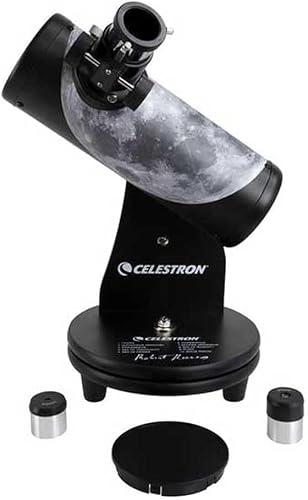
Celestron FirstScope Signature Series Moon Tabletop Dobsonian
- 300 mm focal length tabletop Dobsonian
- 4 mm and 20 mm eyepieces
- Moon map wrap and a free lunar guide
- Light at 4.3 pounds
A light tabletop built around the Moon, with a Moon map on the tube and a 300 mm focal length. It's the gentlest first Dobsonian here, but it's not a deep-sky scope.
Pros
- Light enough to move in one hand
- Moon map and a free lunar guide included
- Simple to set up and store
Cons
- Built around the Moon, so it's narrower for other targets
- No finder scope comes in the box
Celestron's FirstScope Signature Series is a light tabletop built around the Moon. It has a 300 mm focal length, a Moon map wrap on the tube and a free lunar guide download.
At 4.3 pounds, it's the easiest Dobsonian here to lift and move. It's built for the Moon and bright planets, so it's narrower for other targets, and it has no finder scope in the box.
This is the gentlest first Dobsonian in this guide. Buy it if the Moon is your main target and you want a small, simple scope.
Best Dobsonian telescope for a first table
A Dobsonian suits a first scope because the mount is simple. You aim by hand, there's nothing to align, and the big mirror gives plenty of view for the money.
For most people, the choice comes down to a 130 mm tabletop or a 150 mm model. The FirstScope is the light option for buyers who mostly want the Moon.
Best Dobsonian telescope setup on a table
A tabletop Dobsonian needs a steady table or stand. Pick a surface that doesn't shake when you touch the focuser, and keep the scope away from heat sources and open windows.
Let the scope cool outside for about twenty minutes before you look. A warm tube makes the air inside it move, which blurs planets and the Moon's detail.
Set the scope up in daylight the first time. You'll find the focuser, the finder and the eyepiece before the sky is dark, so the first night goes more smoothly.
Keep the tube and finder pointed away from the sun while you practice.
What a Dobsonian shows on different nights
On a bright Moon night, the craters and the edge of the light show clearly in any scope on this list. The smaller models give a sharp, easy view at moderate power, which suits the Moon well.
On a calm night with Jupiter high in the sky, the 130 mm and 150 mm scopes show the cloud bands and Saturn's rings more clearly than the smaller models. The extra light makes the planet look brighter and steadier.
Dark, moonless nights are the best time for fainter targets. A Dobsonian shows more galaxies and nebulae from a dark site than from a city yard, so plan a trip if deep-sky targets are your goal.
Which Dobsonian suits which buyer
A buyer with a small balcony should pick the lightest tabletop, the FirstScope or a 114 mm model. Those keep the weight and the footprint low, and they're easier to move between rooms.
A buyer who wants the biggest view on a table should pick the Heritage 150, if they can lift it. A buyer who wants phone help should pick a StarSense tabletop, since the app finds targets while they learn.
Why the tabletop size matters
A tabletop keeps the scope low and steady, but it limits the mirror size. The bigger the mirror, the more light you gain, and the heavier the tube gets.
Think about where the scope will live before you buy. A tabletop near a window or a shelf is easier to use than one you have to move every time.
Keep a Dobsonian clean and aligned
Keep the mirror covered when the scope isn't in use, and store the tube in a dry room. Dust and damp air change the view over time, so put the dust cap on the front of the tube between sessions.
Over time, a Dobsonian may need collimation, which is a small adjustment that lines up the mirrors. Read the manual before you try it, and do the work in daylight with the tube out of the base.
Why the focuser matters
The focuser sets how easily you can get a sharp image. A smooth focuser makes it easier to hold a planet in focus on a steady night.
The Heritage 150 uses a 1.25-inch helical focuser, which gives fine control once you learn the feel. Practice the focus on the Moon before you try a planet.
A focuser that feels stiff or loose is worth checking early. Read the manual, or contact the maker, before you try to force it.
How we picked these five
We ranked the picks on mirror size, weight, setup, what's in the box and how easy each one is to use on a table. Mirror size carries the most weight, since it decides how much light the scope can gather.
Side by side: five beginner Dobsonians
All five are tabletop models, so weight and focal length decide most of the fit. The Heritage 150 is the heaviest, and the FirstScope is the lightest by a wide margin.
| Product | Best for | Focal length | Weight | Mount | Our score |
|---|---|---|---|---|---|
| Sky-Watcher Heritage 150 Tabletop Dobsonian | the most light on a tabletop | 750 mm | 23 lb | Tabletop Dobsonian | 8.5 |
| Sky-Watcher Heritage 130 Tabletop Dobsonian | a first big-mirror tabletop | 650 mm | 19.2 lb | Tabletop Dobsonian | 8.4 |
| Celestron StarSense Explorer 114AZ Tabletop Dobsonian | phone-guided Dobsonian views | 1000 mm | 12.6 lb | Tabletop Dobsonian | 8.3 |
| Celestron StarSense Explorer 130 mm Tabletop | an app-guided 130 mm tabletop | 650 mm | 19.2 lb | Tabletop Dobsonian | 8.1 |
| Celestron FirstScope Signature Series Moon Tabletop Dobsonian | a light, simple Moon scope | 300 mm | 4.3 lb | Tabletop Dobsonian | 7.2 |
Focal length frames the view, and weight decides how easy the scope is to carry. Pick the one that fits the table you'll use most.
Tabletop or floor base?
A tabletop Dobsonian sits on a table, stand or sturdy box. It's lighter, takes less room and is easy to move between rooms.
Larger Dobsonians often sit on a floor base. They steady better on uneven ground, but they're heavier and take more space in the yard or a spare room.
Which Dobsonian should you buy?
Pick the Heritage 150 if you want the most light and have the room to store it. Pick the Heritage 130 if you want a first big-mirror scope that works the same night.
Pick the StarSense 114AZ or 130 mm if you want phone guidance for finding targets. Pick the FirstScope if the Moon is your main target and the scope needs to be light.
What a Dobsonian telescope shows a beginner
A Dobsonian gives the most light for the money, so you'll see more faint detail than a small refractor shows. It works well on the Moon, bright planets and brighter deep-sky targets from a dark site.
A Dobsonian doesn't track the sky, so a planet drifts out of view. You nudge the tube by hand to follow it, which becomes easy after a few sessions.
Our guide to what is a Dobsonian telescope explains the design in more detail. For the first session, read how to use a Dobsonian telescope.
Dobsonian vs Newtonian: is there a difference?
A Dobsonian is a Newtonian reflector on a simple rocking base. The mirror design is the same, so the choice comes down to the base and the mount.
If you want to compare the design side by side, read Dobsonian telescope vs Newtonian. It explains where the names overlap and where they split.
Keep your eyes safe
Never point a Dobsonian at the sun. This guide does not cover solar viewing, and a finder scope is no safer than the main tube.
The best Dobsonian telescope is the one you'll set up
For beginners with a steady table, the Heritage 150 is the best Dobsonian telescope here, because it gathers the most light. It's a 23-pound lift, so pick the Heritage 130 if you want a big mirror that's ready out of the box and weighs less.
If you want phone guidance, pick a StarSense tabletop, and if you want the lightest scope, the FirstScope is the one to choose.
For the wider picture across budgets, start with the telescope for adults guide. Then see the Celestron StarSense picks if the app matters to you.
Our top 3 picks at a glance
-
1
Best for the most light on a tabletop
Sky-Watcher Heritage 150 Tabletop Dobsonian
8.5/10 our score
See it on Amazon -
2
Best for a first big-mirror tabletop
Sky-Watcher Heritage 130 Tabletop Dobsonian
8.4/10 our score
See it on Amazon -
3
Best for phone-guided Dobsonian views
Celestron StarSense Explorer 114AZ Tabletop Dobsonian
8.3/10 our score
See it on Amazon
Frequently asked questions
What size Dobsonian should a beginner get?
A 130 mm or 150 mm tabletop is a good first choice. The 130 mm weighs less, and the 150 mm gathers more light if you have the table space and can lift 23 pounds.
Are tabletop Dobsonians stable enough?
Yes, on a sturdy table or stand, the view stays steady once you focus. A wobbly surface shakes the image, so set the scope on a firm, level spot.
Do Dobsonians need a tripod?
No, the tabletop models sit on their own base, so they don't need a separate tripod. A floor-standing Dobsonian sits on the ground, and the base does the same job as a tripod.
Is a Dobsonian better than a refractor for a beginner?
A Dobsonian gives more light for the money, while a refractor is simpler to pick up. Choose a Dobsonian if you want the biggest view on a budget, and a refractor if you want a compact, easy start.