How to Use a Dobsonian Telescope
To use a Dobsonian telescope, set the tube on its base, point it by hand, then find a target with the finder before you look through the eyepiece. Its simple altazimuth base is why most beginners find it easy.
On this page (6 sections)
Here's how to use a Dobsonian telescope: set it on a steady surface, aim with the finder, focus slowly and nudge the tube by hand to follow your target. A Dobsonian is a reflector on a simple base, so you can learn those steps in about one clear night.
Most of the work is aiming and focusing, not setup. Once you've done it a few times, a Dobsonian is one of the quickest scopes to use on a clear night.
This guide covers setup, aiming, focusing and sitting comfortably. If you're still choosing a Dobsonian, read what a Dobsonian telescope is first, then compare the picks in the best Dobsonian telescopes.
How to set up a Dobsonian telescope
Setup is short. Put the base on a steady, level surface, fit the tube and check that the finder and eyepieces are in place.
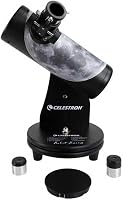
Many tabletop Dobsonians arrive fully assembled, so the first job is often just to clear the table and set the scope down.
Place it on a steady surface
A Dobsonian works best on a surface that doesn't wobble. A bump on the table will shake the image, and a wobbly base makes it hard to hold a target.
Choose a spot on the lawn or a patio if you want to observe outdoors. A flat, firm surface matters more than the exact location.
Check the finder and eyepieces on your Dobsonian telescope
Make sure the finder is attached and lined up, and that the eyepieces sit in their holder. Keep the lens caps handy for the night, so the optics stay clean between sessions.
A finder that's out of line is a common cause of a missed target. Lining it up on a bright star takes a few minutes, and it saves time on every session after.
How to aim and focus a Dobsonian
Aim with the finder first, then look through the eyepiece and fine-tune the view. Moving the tube by hand is quick once you get the feel for it.
Focus slowly, since the sharpest point is easy to pass. Turn the focus knob a little at a time until the image snaps into focus.
Aim with the finder, not the eyepiece
Put the target in the finder's dot or crosshair, then look through the eyepiece. Most of the time, the target will be in the eyepiece's field, and you can center it with small movements.
A bright target, like the Moon or a planet, is easier to find than a faint one. Start with those while you learn the feel of the scope.
Focus slowly
Turn the focus knob a little at a time, and go past the sharp point once, then come back. Overshooting and coming back is the quickest way to find the sharpest image.
If the image is blurry even at the sharpest focus, check the air and the scope's temperature before you blame the optics.
How to move a Dobsonian across the sky
Objects drift across the eyepiece as the Earth turns. A Dobsonian has no motor, so you nudge the tube to follow the target.
Move the tube slowly, in the direction the target is drifting. At lower power, you'll nudge less often, which makes the session more relaxed.
Tracking by hand
Push the tube gently, and keep both hands on the tube so it moves smoothly. Avoid sudden movements, since they shake the image for a few seconds.
At higher power, the target leaves the eyepiece faster, so you'll nudge more often. A lower-power eyepiece keeps the target in view for longer.
Practice on bright targets first
Start with the Moon, since it's bright and easy to find on almost any clear night. Once you can aim and focus on the Moon without thinking, move to a planet, which is a little harder to hold steady.
Practice the motions before you judge the view. Pushing the tube gently, stopping it smoothly and nudging it back to a target are skills that get easier with each session.
Keeping the eyepiece comfortable
Keep both eyes open while you observe, which reduces strain on the eye at the eyepiece. Short sessions with a break now and then keep the view fresh and your back comfortable.
Cooling the scope before you look
A Dobsonian's mirror needs time to reach the outside air temperature. Bring the scope out early, and let it settle while you set up the finder and the eyepieces.
Which Dobsonian fits a first night
The three options below cover different sizes of a tabletop Dobsonian. Each one uses the same basic aim-and-nudge method, so the steps in this guide apply to all of them.
Safety and sitting comfortably
Set the scope at a height where you can sit or stand without bending. A table that's too low forces you to crouch, which makes a long session tiring.
Use a chair or a stool, and keep it close enough to reach the eyepiece without leaning. Comfort matters more than most beginners expect, especially on the second or third night.
Never point a Dobsonian at the sun unless it has a certified solar filter made for that model. Looking at the sun through an unfiltered telescope can cause permanent eye damage, so keep your first targets to the Moon, planets and stars.
How to use a Dobsonian telescope on a clear night
Set the tube on the base, aim with the finder, then focus slowly through the eyepiece. Nudge the tube to follow a target, and step up in power only when the view is steady.
Once you're comfortable with the Moon and the planets, try bright star clusters. For a planet-focused walk-through, read how to find planets with a telescope, and the telescope for adults guide covers the other scope types.
Frequently asked questions
Is a Dobsonian telescope hard to use?
A Dobsonian isn't hard to use, because it has no motor and no alignment step. You move the tube by hand and focus with a knob, and most of the learning is in aiming with the finder and focusing slowly on your first clear night.
Can a Dobsonian be used on a table?
A tabletop Dobsonian is built to sit on a table, which makes it one of the simplest scopes to set up at home. Check that the table is sturdy and at a height where you can sit or stand comfortably before your first session.
How do I keep a target in view with a Dobsonian?
Nudge the tube slowly in the direction the target drifts, with both hands on the tube so it moves smoothly. At higher power, the target moves out of the eyepiece faster, so start at a lower power and step up only when the view is steady.