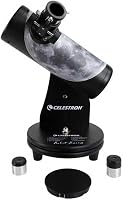
Sky-Watcher Heritage 130 Tabletop Dobsonian Review: Worth It? (October 2026)
The Sky-Watcher Heritage 130 is a 130 mm tabletop Dobsonian that arrives assembled and is simple to aim, which makes it a good first big-mirror scope. It suits a beginner with a sturdy table or patio, and it's a weaker pick for someone who wants motorized tracking or a tripod-mounted scope.
On this page (18 sections)
- Sky-Watcher Heritage 130 at a glance
- Is the Heritage 130 good for beginners?
- How a tabletop Dobsonian works
- What you can see from a 130 mm tabletop
- Eyepieces and magnification
- Setting up the Heritage 130
- Comfort at the eyepiece
- Who the Heritage 130 suits best
- Heritage 130 or 150?
- First clear night with the Heritage 130
- Mirror care and collimation
- Observing from a balcony or patio
- What galaxies and clusters look like
- What comes in the box
- Pros and cons
- Who should skip the Sky-Watcher Heritage 130
- Sun safety with a Dobsonian
- Verdict: the Sky-Watcher Heritage 130 for a simple first big mirror
The Sky-Watcher Heritage 130 is a tabletop Dobsonian with a 130 mm mirror. It arrives assembled, so the first night can start with the sky instead of the instructions.
This review covers the base, what the scope shows, the eyepieces and the trade-offs. It also explains who should skip it, since a Dobsonian is a different kind of scope from a tripod telescope.
Sky-Watcher Heritage 130 at a glance
The Heritage 130 has a 130 mm mirror, a 650 mm focal length and an altazimuth Dobsonian mount. It ships with 10 mm and 25 mm eyepieces and a red dot finder, and the tube collapses for storage.
Sky-Watcher Heritage 130 Tabletop Dobsonian

- 130 mm Dobsonian reflector, fully assembled
- Collapsible tube design
- 10 mm and 25 mm 1.25-inch eyepieces
- Red dot finder included
A ready-to-use tabletop scope with a 130 mm mirror, for a buyer who wants a simple first look from a table.
Pros
- Fully assembled out of the box
- A collapsible tube that's easier to store
- Sky-Watcher gives it a two-year warranty
Cons
- Needs a sturdy table or base for steady views
- Doesn't track targets across the sky
Our score weighs specs, features and buyer feedback against what you're shopping for.
Is the Heritage 130 good for beginners?
Yes, if you have a sturdy table or a patio spot with a solid base. The scope's simple design lets you focus on the sky instead of the setup.
It's a less natural fit for someone who wants the scope to track targets or move under motor power. That's a trade-off of the Dobsonian style, and it matters less on a first night than it might seem.
How a tabletop Dobsonian works
A Dobsonian mount is a rocker base with a smooth bearing surface, and the tube sits on top. You push the tube up and down and side to side by hand, which is quicker than turning knobs on a tripod head.
The Heritage 130 sits on a table, so it skips the tripod. Set it on a flat, sturdy surface and the scope is ready to use.
What you can see from a 130 mm tabletop
The Moon is the best first target, showing craters and sharp shadows along its edge. Jupiter's bands and moons show on a steady night, and Saturn's rings look like a clear shape at moderate power.
Star clusters look bright and full of points of light. Galaxies look like faint, small smudges, so set that expectation before you aim at one.
Eyepieces and magnification
The 25 mm eyepiece gives about 26 times power on the 650 mm focal length. The 10 mm eyepiece gives about 65 times.
Start with the 25 mm for the Moon and wide views, then switch to the 10 mm for planets. Higher power dims the view and shows more of the air's shake, so move up only when the image stays sharp.
The 650 mm focal length gives each eyepiece a fairly steady view for its power. That makes the 25 mm a comfortable first eyepiece for the first night.
Setting up the Heritage 130
The scope comes fully assembled, so there's no build before the first night. Set the scope on a flat table and check that it can swing without bumping a wall.
A table that wobbles shakes the view, so pick a surface that doesn't move when you touch the focuser. The Heritage 130 weighs about 19 pounds, which is manageable for one adult.
Sky-Watcher Heritage 130 setup on a table
Set the base where the table is firm and level, and keep it away from the table's edge so the base has room to move. Check for a clear swing, since the tube moves up and down and side to side, and keep chairs and walls out of that arc.
A dining table or a workbench with solid legs is a better fit than a light folding table. Test the scope on the table before a dark session, so you know the view is steady when you touch the focuser.
Comfort at the eyepiece
A Dobsonian's eyepiece sits high on the tube, so your head position matters. A stool or a chair helps you reach the eyepiece without straining your neck.
Check the height during setup, and move the table or your seat until the eyepiece is easy to reach. A comfortable height keeps a session going longer, which is when most of the view happens.
Who the Heritage 130 suits best
It suits a beginner with a table or patio who wants a simple first big mirror. It also suits a family scope that gets used on a few clear nights each month.
It's a good fit for a buyer who wants to learn the sky by sight first. The Dobsonian mount is quick to aim, so you spend more time looking than adjusting.
Heritage 130 or 150?
The 150 is the bigger sibling, with a 150 mm mirror and a 750 mm focal length. It gathers about a third more light, and it weighs about 23 pounds.
If the 130 is the right size for your table and your back, it gives you most of the same views. The Heritage 130 vs 150 comparison lays out the trade-off in more detail.
First clear night with the Heritage 130
Start with the Moon at the 25 mm eyepiece, since it's the easiest target to find and the view is wide enough to aim with. Let your eyes adjust, then move slowly across the sky until the Moon appears in the finder.
Once the Moon is sharp, try a bright planet such as Jupiter at the 10 mm. Expect a small, bright disc rather than a detailed picture, and give the view a few minutes for the air to settle.
Mirror care and collimation
The Heritage 130 is a Newtonian-style reflector inside a Dobsonian tube, so its mirror needs the same care as any reflector. Cap the tube when the scope is not in use, and keep the mirror free of dust.
Mirror alignment can drift after a long move. A star that looks like a comet tail or a fuzzy triangle at high power can mean the mirrors need a check, so check the manual for the steps.
Observing from a balcony or patio
A tabletop scope can sit on a sturdy balcony table if the floor is solid and level. Keep the base away from the rail, and check that the table's legs sit on a firm, flat surface.
A patio table gives you more room to swing the tube, which makes it easier to follow a target across the sky by hand.
What galaxies and clusters look like
Star clusters look bright and full of stars through the 130 mm mirror. Galaxies look small and faint, and a few of the brightest appear as gray, soft smudges.
Give faint targets time to show up. Let your eyes adjust for a few minutes, and use averted vision, looking just to the side of a faint target, to bring out more detail.
What comes in the box
The box holds the assembled scope with its 130 mm mirror, a 10 mm and a 25 mm 1.25-inch eyepiece, a red dot finder, a lens cap and a manual. Sky-Watcher says the mirror carries Radiant Aluminum Quartz coatings.
There's no tripod to buy, since the base is part of the scope. Plan on a Barlow lens or a third eyepiece later if you want more power.
Pros and cons
- Pros: it arrives assembled, so the first night starts quickly.
- Pros: the collapsible tube makes storage easier, and the two eyepieces are included.
- Pros: Sky-Watcher gives it a two-year warranty against defects in materials and workmanship.
- Cons: it needs a sturdy table or base, and a wobbly surface shakes the view.
- Cons: the scope doesn't track targets across the sky, so you aim it by hand.
Who should skip the Sky-Watcher Heritage 130
Skip it if you want a tripod-mounted scope that stands on the floor. A tabletop Dobsonian sits on a table, so it needs that surface.
Skip it if you want motorized tracking or a telescope for long photo sessions. This scope is built for visual looks at the sky.
Skip it if you need the lightest possible scope for travel. A 19-pound tube is manageable at home, but it's a bigger load for a long walk.
Sun safety with a Dobsonian
Never point the tube or its finder at the sun, even for a moment. Looking at the sun through an unfiltered telescope can cause permanent eye damage, and the finder is no safer than the main tube.
Verdict: the Sky-Watcher Heritage 130 for a simple first big mirror
The Sky-Watcher Heritage 130 is a sensible first big-mirror scope for a beginner with a sturdy table. It arrives assembled, sets up in minutes and shows the Moon and planets clearly on a steady night.
Read the best Dobsonian telescope roundup to compare it with other tabletop choices, and how to use a Dobsonian telescope for the first-night routine.
Frequently asked questions
Is the Sky-Watcher Heritage 130 good for beginners?
Yes, for a beginner who has a sturdy table or patio. It's simple to aim and it comes assembled, so most of the first-night effort goes into finding targets and focusing on the Moon and planets.
Does the Heritage 130 need a tripod?
No, the base and tube are one unit that sits on a table. The table still has to be steady enough to hold the scope still.
What does the Heritage 130 come with?
It comes with 10 mm and 25 mm eyepieces and a red dot finder, so you can start observing without buying extras. Sky-Watcher says it is fully assembled, so no build is needed before the first night.
How heavy is the Heritage 130?
It weighs about 19 pounds, which is manageable for one adult, though you'll want a firm grip and a short walk to the table. The tube collapses for storage, which helps when the scope has to fit a closet.