Telescope vs Binoculars for Stargazing: Which Is Better? (October 2026)
Binoculars give the easiest first night, with wide views of star clusters, the Milky Way and the Moon, while a telescope shows more detail on planets. Pick binoculars if you want to start tonight, and pick a telescope if the planets and the Moon's craters are your main goal.
On this page (15 sections)
- Binoculars or a telescope: what each one shows
- What binoculars show you
- What a telescope shows you
- Magnification and steadiness
- Light gathering: why bigger lenses help
- Field of view: the wide view against the close view
- Setup and time on the first night
- Skills each one asks for
- Sun safety for both
- What each one can't do well
- A mixed plan for a first year
- Which to take on a camping trip
- A quick checklist
- Which should you buy first?
- Binoculars or a telescope: the closing choice
Binoculars are the easier first night, and a telescope is the better tool for planets and Moon detail. Binoculars give you a wide view with both eyes, which is comfortable for exploring.
A telescope narrows the view and magnifies it, which is what you need for planets.
Most first-time buyers can enjoy either one. The choice depends on what you want to see first and how much setup you're willing to do before the first look.
Binoculars or a telescope: what each one shows
Binoculars give a wide field, so you can sweep across the Milky Way, scan the star clusters and find the Moon without a long hunt. Two eyes make the view easier to enjoy for a long session.
A telescope gives more magnification, so planets look larger and show more detail. On a steady night, Jupiter's bands and moons and Saturn's rings can appear through a telescope with a 90 mm or larger aperture.
What binoculars show you
A 10x50 pair is a common astronomy choice. The Celestron UpClose G2 10x50 has multi-coated BK-7 prisms, is water-resistant and comes with a carrying case, so it's a simple grab-and-go pair for a backyard.
Binoculars also suit a short session. You can pick them up, step outside and start looking in a minute, with no focus routine and no tripod to lock down.
What a telescope shows you
A telescope's view is narrower. That makes it harder to find a big target, since you are looking through a small window on the sky and need to aim before you look.
What you get in exchange is detail. A telescope can show the Moon's craters in sharper relief and planets as discs rather than points.
Magnification and steadiness
Power is only part of the story. Higher power magnifies shake as well as detail, so a binocular at 10 power is much steadier in the hand than one at 15 power.
The Celestron SkyMaster 15x70 is a good example of that trade-off. It has 70 mm lenses and gathers much more light, but most users mount it on a traditional photo tripod, which is not included.
A telescope has the same steadiness issue, but the mount and tripod do most of the work. Once the scope is set up and aimed, the view stays put without holding anything by hand.
Light gathering: why bigger lenses help
Light-gathering power grows with the square of the diameter. A 70 mm binocular lens gathers about twice the light of a 50 mm lens, and a 130 mm telescope mirror gathers far more than either pair of binoculars.
That gap matters on faint targets such as star clusters and galaxies. A bigger aperture shows more points of light and a brighter smudge, which is why many people step up to a telescope once they want more from the night sky.
Binoculars still have an edge on wide, faint areas like the Milky Way. A telescope's narrow view can't match that sweep, even with a big mirror.
Field of view: the wide view against the close view
Binoculars show a wide slice of sky at once, which helps you learn the constellations. You can see how stars sit next to each other, and that makes star hopping easier later.
A telescope shows a smaller piece of sky. That is why you use the finder to get on target, and why a target that's easy to spot in binoculars can be tricky in a telescope.
Telescope vs binoculars: field of view in practice
The wide view of binoculars makes the Moon easy to frame and easy to find. A telescope's narrow view turns the same target into a small detail you have to hunt for.
Use binoculars to find the general area of a target, then switch to a telescope when you want more detail. A telescope finder can work the same way, letting you locate the target before you look.
Setup and time on the first night
Binoculars need almost no setup. You grab them, focus each eyepiece once and start looking, which makes them ideal for a quick look after dinner.
A telescope takes more time. You set up a tripod, attach the tube, align a finder and focus, and that routine may take half an hour the first time.
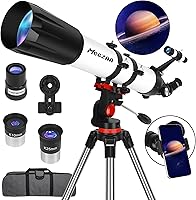
A kit such as the MEEZAA 90 mm refractor includes a tripod, a phone adapter and a carry bag, so you can start with one box.
Skills each one asks for
Binoculars ask for steady hands and a sense of direction. Once you're outside, you find the sky by sweeping across it and recognizing the patterns.
A telescope asks for patience with aim and focus. You learn to use the finder, to focus slowly and to check the view once the target is centered.
Sun safety for both
Never point binoculars or a telescope at the sun unless you have a certified solar filter made for that instrument. Looking at the sun through an unfiltered optic can cause permanent eye damage in a moment.
Daylight setup is no excuse to test the aim. Keep both instruments capped or stored during the day, and check that no one is looking toward the sun through them.
What each one can't do well
Binoculars can't show planetary detail as well as a telescope. A planet looks like a small, pale dot in a binocular, and the rings of Saturn are hard to make out.
A telescope can't show the wide sweep of the Milky Way the way binoculars can. Its narrow view makes the sky feel smaller, and finding a large target like the Pleiades takes more practice than a quick scan with binoculars.
Both need dark skies for faint targets. A bright porch light or a street lamp hurts either choice, so pick a spot away from light.
A mixed plan for a first year
A good plan is to start with binoculars for the first few weeks, then add a telescope once you know the sky. Binoculars teach you the constellations, which makes the telescope easier to aim.
Others start with a telescope for the Moon and planets, then add binoculars for wide sweeps. Either path works, and you can use the same clear nights for both.
Which to take on a camping trip
Binoculars win on a camping trip, since they fit in a pocket and need no setup at the campsite. A telescope suits a trip where the car can carry the tripod and you'll set up in one spot for several nights.
A quick checklist
Pick binoculars if you want to start tonight, have little time for setup and want a wide view. Pick a telescope if the Moon and planets are the main goal and you're willing to set up each time.
Which should you buy first?
Pick binoculars if you want to start tonight with little setup and a wide view of the sky. They're also a good second step for a telescope owner, since they show parts of the sky a narrow scope misses.
Pick a telescope if the Moon and planets are your main goal. A telescope with a 90 mm or 130 mm aperture shows more detail on planets, and it grows with you as you learn to find targets.
For a first telescope that's ready for planets, what you can see with a telescope lists the targets a first telescope shows. If you want to compare scope designs, refractor vs reflector telescope explains the choice.
Binoculars or a telescope: the closing choice
Binoculars and a telescope work well together, and many backyard observers keep both. Start with the one that gets you outside, then add the other when you know what you want to see next.
If planets are the first goal, can you see planets with a telescope explains what a beginner scope shows. If you're still choosing a first scope, how to choose a telescope for beginners covers the rest of the trade-offs.
For a full review of a telescope that fits this comparison, read the MEEZAA 90mm Refractor Telescope Review.
Frequently asked questions
Are binoculars good enough for stargazing?
Yes, for wide views of the Milky Way, star clusters and the Moon. Binoculars can't show planetary detail as well as a telescope, so they suit a first night best when you want to explore the sky broadly.
What size binoculars are best for astronomy?
A 10x50 pair is a common choice, since 10 power is steady in the hand and 50 mm lenses gather a good amount of light. Larger pairs, such as 15x70, gather more light but need a tripod to hold steady.
Can binoculars show Saturn's rings?
Usually not clearly. Saturn looks like a small, pale point in most binoculars, while a telescope with a 90 mm or larger aperture can show the rings as a distinct shape on a steady night.
Should I get binoculars or a telescope first?
Binoculars are the easier first step, since you can use them the same night without setup. If you want planets and detail on the Moon, a beginner telescope is the better long-term choice.