MEEZAA 90mm Refractor Telescope Review: Worth It? (October 2026)
The MEEZAA telescope is a 90 mm refractor with a tripod, a carry bag and a phone adapter, and it works best on the Moon and bright planets. It suits a beginner who wants a small, simple scope for trips and family use, and it's a weaker pick for faint galaxies or for anyone who wants the most light for the money.
On this page (17 sections)
- MEEZAA 90 mm refractor at a glance
- Are MEEZAA telescopes good for beginners?
- What a 90 mm refractor shows
- Tripod and setup
- The 800 mm focal length and the eyepieces
- What a 90 mm refractor does well
- Refractor tube, finder and eyepiece height
- Who the MEEZAA kit suits best
- A first-night routine with the MEEZAA
- Storage and transport
- Eyepiece and Barlow notes
- Where the MEEZAA fits in a list of beginner scopes
- Problems to expect with a kit this size
- Sun safety with a refractor
- Pros and cons
- Who should skip the MEEZAA 90 mm refractor
- Verdict: the MEEZAA 90 mm refractor for a portable first look
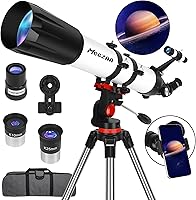
The MEEZAA telescope is a 90 mm refractor on an adjustable tripod, sold as a complete kit with a carry bag and a phone adapter. It's a small, portable scope that suits trips, family use and a first look at the sky.
This review covers the optics, the tripod, what the scope shows and where its limits are. It also covers who should skip it, since a 90 mm refractor gathers less light than a 114 mm or 130 mm reflector.
MEEZAA 90 mm refractor at a glance
The scope has a 90 mm lens, an 800 mm focal length and an altazimuth mount on a tripod that adjusts from 28 to 46 inches. The kit includes 10 mm and 25 mm eyepieces, a 3x Barlow lens, a finder, a phone adapter and a carry bag.
MEEZAA 90 mm 800 mm Refractor

- 90 mm aperture and 800 mm focal length
- 10 mm and 25 mm eyepieces with a 3x Barlow lens
- Adjustable stainless steel tripod, 28 to 46 inches
- Carry bag and phone adapter included
A portable 90 mm refractor with a tripod, a carry bag and a phone adapter, for a family or a first look at the Moon and planets.
Pros
- Tripod, carry bag and phone adapter included
- Simple to set up on a patio or lawn
- Sharp views of the Moon at moderate power
Cons
- A 90 mm lens gathers less light than a 114 or 130 mm reflector
- The highest power shown looks dim and soft on a scope this size
Our score weighs specs, features and buyer feedback against what you're shopping for.
Are MEEZAA telescopes good for beginners?
For a simple first look, yes. The refractor tube is compact, the tripod is adjustable and the kit has everything in one bag.
The scope isn't built for deep-sky views. It shows the Moon and bright planets well, while faint galaxies and nebulae look small and dim.
What a 90 mm refractor shows
The Moon is the best target, with crater edges and shadows that stand out at moderate power. Jupiter shows its bands and moons on a steady night, and Saturn looks like a small ringed planet.
Bright star clusters show as scattered points of light. Galaxies look like faint smudges, which is normal for a scope this size.
Tripod and setup
The tripod is a stainless steel model that adjusts from 28 to 46 inches, so you can set the eyepiece at a comfortable height for sitting or standing. The tube attaches quickly, and the carry bag holds the parts together for trips.
Keep the tripod on a firm, level spot. A loose tripod shakes the view more at higher power, and the tube has nothing else to steady it.
The kit includes a phone adapter, which lets you take quick pictures of the Moon through the eyepiece. It's a fun extra for a family night, though it isn't a full astrophotography setup.
MEEZAA telescope tripod height and carrying
Set the tripod height so your eye sits near the eyepiece without bending. A shorter setting is steadier at high power, so keep the legs low when you use the Barlow.
Carry the tube and the tripod separately, and keep the eyepieces in the bag to avoid scratches. The bag keeps the parts together, so nothing gets lost on the way to a dark site.
The 800 mm focal length and the eyepieces
The 25 mm eyepiece gives about 32 times power on the 800 mm focal length. The 10 mm gives about 80 times, and the 3x Barlow multiplies that to about 240 times.
MEEZAA quotes a magnification range up to 240 times. That number is real arithmetic, but a 90 mm scope shows little at that power, since the image gets dimmer and softer as magnification rises.
Most good views come from the 25 mm and the 10 mm without the Barlow. Add the Barlow only when the view is steady and you want a closer look at the Moon.
What a 90 mm refractor does well
A refractor's clean optical path gives crisp, high-contrast views of the Moon. The craters and the terminator, where light and shadow meet, look sharp at moderate power.
Cheaper refractors can show a faint color fringe around bright objects. You may see a little of that around the Moon or Venus, and it's a normal trade-off for a scope in this class.
A refractor has no central obstruction, because the light path stays clear of a secondary mirror. That helps keep contrast high on the Moon and planets, even at a modest aperture.
Think of the 90 mm as a good Moon and planet scope rather than a deep-sky one. Set that expectation before the first night, and the results will feel better.
Refractor tube, finder and eyepiece height
The refractor tube is simple: a lens at the front and an eyepiece at the back. That layout puts the eyepiece at a comfortable height on the tripod for most adults.
The included finder is a straight-through model, so you aim by lining up the sight with your target. Practice this on the Moon before you try a fainter object.
Who the MEEZAA kit suits best
It suits a beginner who wants one bag with everything in it. It also suits a family that wants a simple scope for a few outings a year, or someone who plans to take a scope on a trip.
It's less suited to someone who already knows they want deep-sky views. Faint targets need more light than a 90 mm lens gathers.
A first-night routine with the MEEZAA
Set up in daylight if you can, so the tripod and tube are ready before dark. Line up the finder on a distant rooftop or tree, never the sun, so the aim is easier after dark.
Once it's dark, start with the Moon at the 25 mm eyepiece. Then try the 10 mm for planets, and add the Barlow only when the view is steady.
Storage and transport
The carry bag keeps the parts together, which makes the scope easy to store in a closet. Keep the bag dry and cap the tube before you store it, so dust stays out of the optics.
On a trip, pick a flat, level spot at the site before you set up. A tripod on soft ground shifts under its own weight, which moves the target out of the eyepiece.
Eyepiece and Barlow notes
The 25 mm eyepiece is the easiest to use, since it shows a wide, bright patch of sky that's easy to frame. The 10 mm is the next step for planets once the view is steady.
The 3x Barlow multiplies the power of either eyepiece, so the view gets smaller and dimmer. Use it as a finishing tool for a closer look, not as your starting point.
Where the MEEZAA fits in a list of beginner scopes
Among beginner scopes, the MEEZAA is a refractor, and reflectors usually offer more aperture for the size. It's a sensible choice for a portable first look, and a weaker choice for a faint-object hunt.
If you're weighing it against a reflector, the refractor vs reflector telescope comparison covers the main differences. A kit this size also fits in a car trunk, which makes it easy to take to a dark spot outside town.
Problems to expect with a kit this size
Most first-night frustrations with a small refractor come from the tripod and the aim, not the optics. Set the legs firmly and lock the height before you look.
Color fringes and dim high-power views are the two limits to expect from a scope this size. Both are normal for a 90 mm refractor, so use moderate power and expect a steady, modest view rather than a bright one at 240 times.
Plan on a few minutes of practice with the finder before the first target is centered. A straight-through finder is simple, but it takes a steady eye and a clear target to line up.
Sun safety with a refractor
Never point the tube or its finder at the sun, even for a moment. Looking at the sun through an unfiltered telescope can cause permanent eye damage, and a stray sunbeam through the lens can also damage the finder or the eyepiece.
Cap the tube whenever you set the scope down in daylight.
Pros and cons
- Pros: the tripod, carry bag and phone adapter come in the kit, so you can start the same day.
- Pros: the refractor tube is easy to carry and quick to set up on a patio or lawn.
- Pros: the Moon views are sharp at moderate power.
- Cons: a 90 mm lens gathers less light than a 114 mm or 130 mm reflector.
- Cons: the highest power shown looks dim and soft on a scope this size.
Who should skip the MEEZAA 90 mm refractor
Skip it if you want faint galaxies or nebulae. A larger reflector gathers more light and shows more of those targets.
Skip it if you want the most aperture for your budget. A 114 mm or 130 mm reflector gives more light, and the refractor vs reflector telescope comparison explains why.
Skip it if you plan to photograph the sky. The phone adapter is for quick pictures of the Moon, not for long astrophotography sessions.
Verdict: the MEEZAA 90 mm refractor for a portable first look
The MEEZAA telescope is a practical, portable refractor for a beginner who wants a simple first look at the Moon and bright planets. The kit is complete, and the tripod and carry bag make it easy to take along.
For a side-by-side look at a reflector, read Celestron AstroMaster 130EQ Review. If you're also weighing binoculars, telescope vs binoculars for stargazing covers the trade-off.
Frequently asked questions
Is the MEEZAA telescope good for beginners?
Yes, for a simple first look at the Moon and bright planets. It's a small refractor that sets up quickly, though it gathers less light than larger scopes, so faint galaxies will look small.
Is a 90 mm refractor good for planets?
It shows the Moon and the brightest planets clearly on a steady night. Jupiter and Saturn show as small, sharp discs at moderate power, and the view gets dimmer as power rises.
What comes in the MEEZAA kit?
The kit includes the tripod, 10 mm and 25 mm eyepieces, a 3x Barlow, a finder, a phone adapter and a carry bag. You'll still want a clear sky and a flat spot for the tripod.
Can a MEEZAA 90 mm refractor show galaxies?
Only faintly, and mostly the brightest ones. Galaxies look like small gray smudges through a 90 mm scope, so set that expectation before you aim at one.