What Telescope Can See Saturn's Rings?
A telescope with a lens or mirror of about 70 mm or larger can see Saturn's rings as a tilted oval. Most beginner scopes in this guide meet that size, so you have plenty of choice.
On this page (8 sections)
- Which telescope can see Saturn's rings?
- What Saturn's rings look like through a beginner telescope
- What telescope size can see Saturn best?
- Why medium power works best for Saturn
- How to find Saturn on your first night
- Can you see Saturn's moons too?
- Never point a telescope at the sun
- Pick a telescope that can see Saturn and get out tonight
What telescope can see Saturn's rings? Any scope with a lens or mirror of about 70 mm or larger, which covers most beginner scopes in this guide.
The rings look like a tilted oval around a small, pale disk. They're the reason many adults buy their first telescope, and they show up on the first clear night you try.
Which telescope can see Saturn's rings?
Any telescope with about a 70 mm lens or mirror, used at moderate power, shows the rings as a tilted oval. That covers small refractors and the bigger reflectors in this guide.
Larger scopes show more of the planet and the rings. The extra light helps the rings look brighter, and it can show fine details on a calm night.
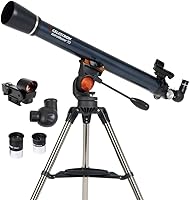
An 80 mm refractor is a sensible first step. The Koolpte kit has an 80 mm lens with a 600 mm focal length, which frames Saturn well at moderate power.
What Saturn's rings look like through a beginner telescope
The rings look like a thin, pale oval wrapped around a small disk. Their width is roughly twice the planet's width, so the whole shape reads as one wide, tilted outline.
In steady air, a larger scope can show a dark gap in the rings, called the Cassini Division. It's a faint line, so look for it on a calm night and give your eyes a few minutes to adjust.
Titan, Saturn's largest moon, shows as a small point of light beside the rings in many small scopes. It's a nice target once you've found the planet.
What telescope size can see Saturn best?
A 70 mm refractor is the smallest scope that reliably shows the rings. Larger reflectors from 114 mm to 130 mm show more detail, and the rings look brighter.
A bigger mirror also gathers more light for the faint details around the planet. The trade-off is weight, since bigger scopes are heavier to carry outside.
Scopes near 70 mm show Saturn as a clear oval. The 114 mm and larger scopes show the rings with more contrast on steady nights, so pick the size that matches the space and weight you're happy to handle.
The LT 114AZ is a balanced choice. Its 114 mm reflector sits on a tripod, and the app can point you to Saturn once you pick it from the list.
For a bigger mirror on a simple base, the Heritage 130 is a tabletop option. It arrives assembled, so you can use it on the first night.
Why medium power works best for Saturn
Saturn looks best at moderate power. Too much power makes the planet dim and soft, because the air limits the sharpness of the view.
Start with a middle eyepiece. Move to a higher power only if the image holds steady, and go back down the moment it starts to shimmer.
How to find Saturn on your first night
Saturn shines with a steady, non-twinkling light, so it's easier to spot than most stars. A sky app or chart tells you where it sits tonight, and that saves a lot of searching.
Let the scope cool outside for at least twenty minutes before you look. A warm tube makes the air inside it move, which blurs the view.
What you can see of Saturn in a telescope
Open the app or chart before you set up, so you know where to aim. Find Saturn with the finder scope first, and then check the eyepiece.
If you want more light for the rings, the Heritage 150 gathers the most light of the tabletop picks in this guide. It has a 750 mm focal length and a collapsible tube.
Can you see Saturn's moons too?
Titan is the easiest of Saturn's moons to see. Other moons need a larger aperture or a darker sky, so don't expect a long list on your first night.
Once you find Titan, you have a clear sense of how far the moon sits from the planet. It's a good reason to keep the scope out a few more minutes.
Saturn's rings tilt over time. They turn edge-on to Earth about every fifteen years and nearly vanish, as they did in 2025, then open wider each year toward the early 2030s.
Never point a telescope at the sun
Never point your telescope at the sun, even while you look for Saturn. The sun can cause permanent eye damage in an instant, and this guide does not cover solar viewing.
Pick a telescope that can see Saturn and get out tonight
A telescope with about a 70 mm lens or mirror can see Saturn's rings, and a 114 mm to 130 mm scope shows more of the detail. Pick the size you'll carry out on a clear night.
For a wider look at what you can see planet by planet, read can you see planets with a telescope. If you want to find the planets on your own, follow how to find planets with a telescope.
For the best scopes for planets, our best telescopes for viewing planets guide compares the picks, and the telescope for adults guide covers the rest of the choices.
Frequently asked questions
Can a 70 mm telescope show Saturn's rings?
Yes, a 70 mm refractor usually shows Saturn's rings as a small oval on a steady night. Use moderate magnification and wait until the planet climbs higher, where the air is usually steadier.
Can you see Saturn's rings with binoculars?
Binoculars show Saturn as a small, dim dot, and the rings usually can't be seen as rings. A telescope is the tool that shows the rings clearly, since binoculars rarely magnify enough to see the ring shape.
How big does Saturn look in a telescope?
Saturn looks small even through a good scope. At moderate power, it's a tiny, tilted oval, much smaller than the Moon, so a steady view matters more than a big picture.